
Reporting quality and metrological traceability of 222-nm far-UVC dosimetry: a systematic review and metascientific audit
Calidad del reporte y trazabilidad metrológica de la dosimetría far-UVC a 222 nm: revisión sistemática y auditoría metacientífica
MedETechni, Santiago, Chile
Original published · English translation
https://doi.org/10.68897/mjtr.2026.e0003.enEnglish translation of the Spanish original, prepared by the journal with AI assistance and checked for text, numbers, tables and references. Disclosures and manuscript-approval statements translated below concern the original study. Figures retain their original labels; captions and tables are translated. Original DOI: 10.68897/mjtr.2026.e0003.es.
Abstract
Objective. To reconstruct published exposure schedules for 222-nm far-UVC, check their arithmetic consistency, and characterize the dosimetric and metrological-traceability information needed to interpret them.
Methods. A retrospective systematic review and cross-sectional audit of 84 reports. Irradiance, time and radiant exposure were linked within each schedule, units were normalized, and H = E × t was recalculated. Arithmetic discrepancies and dimensional problems were assessed separately. The exploratory FDRI-28 instrument evaluated reporting of source and spectrum, measurement, geometry, exposure and context. Two reviewers ratified scores, eligibility and corpus versions.
Results. Twenty-three reports permitted evaluation of a linked irradiance–time–exposure schedule; 21 agreed within 5% and two showed discrepancies greater than 10%. In Welch (2018), 0.0997 mW/cm² for 20 s reproduced 1.994 mJ/cm² against a reported 2 mJ/cm². In Memic (2024), 0.0058 mW/cm² for 28,800 s produced 167.04 mJ/cm² against 150 mJ/cm², a difference of 11.36%. In Gruode (2023), a literal interpretation of 1.90 W/cm² for 10 s produced 19,000 mJ/cm² against 19 mJ/cm², a factor-of-1,000 discrepancy. Four unit or dimensional problems were identified. Mean reporting completeness was 45.72% of applicable items; radiometry/calibration had the lowest completeness (15.67%).
Conclusions. Reconstruction of the 23 schedules distinguishes concordant calculations, numerical discrepancies and unit problems. The linked-value table makes the inputs and conversions supporting each comparison explicit. Source, instrument, calibration and geometry documentation determines how a stated exposure can be interpreted; arithmetic agreement describes its internal consistency, while traceability additionally requires information about the measurement.
Key points
Question. Which exposures can be reconstructed from published irradiance and time values, and what information permits assessment of their traceability?
Findings. Of 84 reports, 23 allowed a linked schedule to be checked: 21 agreed within 5% and two showed differences greater than 10%. The reconstruction table presents irradiance, time, reported exposure, recalculated exposure and relative discrepancy for these 23 reports. Mean reporting completeness was 45.72%.
Meaning. The audit links exposure values to their sources and distinguishes arithmetic consistency, dimensional problems and metrological documentation.
Plain-language summary
This review examined how exposure to 222-nm far-UVC light was described and calculated in 84 reports. In 23, irradiance could be linked to a time and a stated exposure so that the calculation could be repeated. Twenty-one agreed within 5%; two showed differences greater than 10%. For example, an irradiance of 0.0058 mW/cm² for eight hours gives 167.04 mJ/cm², against 150 mJ/cm² reported in one study. The audit shows the values supporting each check and examines documentation of the lamp, instrument, calibration and geometry. It therefore distinguishes a reproducible calculation from a measurement whose traceability is also documented.
Introduction
Health-related research using 222-nm far-UVC encompasses controlled experiments with microorganisms and tissues, animal and clinical observations, implementation in occupied spaces, environmental measurements, indoor-air chemistry and dosimetry. Across these designs, administered optical exposure is a central input. Efficacy, biological response and comparison with exposure guidelines are interpreted against the amount and spectrum of radiation reaching a target. If the measurement chain or geometry is not described, the same nominal radiant exposure may not represent the same physical exposure across studies.
Ultraviolet radiometry depends on the source and detector. A broadband radiometer combines the source's spectral irradiance with the detector's wavelength-dependent responsivity. Out-of-band response, spectral mismatch between calibration and test sources, nonlinearity, geometry and field nonuniformity can alter the displayed irradiance [3–5]. CIE 220:2016 describes methods for characterising and calibrating UV radiometers [3]. Spectral-mismatch experiments with commercial UV-C radiometers show that source-specific correction can materially change reported readings [5]. For KrCl sources, nominal 222-nm emission, optical filtering, weaker emission at longer wavelengths, reflective boundaries and target-plane location can affect interpretation [6,7].
Arithmetic checking is one component of reproducibility. The identity
H (mJ/cm²) = E (mW/cm²) × t (s)
allows a linked radiant-exposure scheme to be recalculated, but agreement does not establish that irradiance was measured in the correct plane, with a suitable calibrated detector, or with quantified uncertainty. Reproducibility encompasses both arithmetic and the measurement model.
This systematic review assesses dosimetric reporting completeness through a cross-sectional metascientific audit of a curated corpus. The corpus was reconstructed retrospectively and cleaned by families of full-report versions. The design examines information in the selected documents; search coverage and its relationship to the wider literature are described in Methods.
Objectives were to: (1) reconstruct locally linked irradiance–time–radiant-exposure schedules and check their units and arithmetic consistency; (2) describe source, measurement, geometry, exposure and context components using FDRI-28; and (3) identify reports meeting joint basic-reporting and traceability criteria. The unit of analysis was the report. Published and recalculated values are presented by schedule; documentary scores describe the information available to interpret them.
Methods
To show the reconstruction, one representative schedule is presented for each of the 23 evaluable reports in the audit matrix. Published E, t and H values are retained, and H is recalculated in mJ/cm² from E in mW/cm² and t in seconds. Relative discrepancy is 100 × |reported H − recalculated H|/|reported H|. The table does not aggregate arms or doses from the same report as independent studies and does not assume that one schedule represents all its experimental conditions.
Design and unit of analysis
A retrospective systematic review and cross-sectional metascientific audit of a curated corpus were conducted. Reporting completeness was assessed by report after its versions were unified. The protocol and statistical plan were documented on 17 August 2026 to establish rules for corpus reconstruction and analysis. Both were retrospective, without registration or specification before the original screening and extraction.
Corpus selection and version control
The final corpus was obtained from 81 reports, four additions and exclusion of HF06-0710 because it lacked an arm measured specifically at 222 nm, giving 84 reports in total.
The initial set contained 83 records. We excluded HF06-1010 as a conceptual technical note without direct empirical measurement and removed HF06-1013 because the bioRxiv record duplicated the final article retained as HF06-1203. We replaced the metadata and source of the obsolete HF06-0673 preprint with the final Scientific Reports article (doi:10.1038/s41598-022-08462-z), and replaced HF06-0931 with the final Building and Environment article's metadata (doi:10.1016/j.buildenv.2025.112734). Extraction for HF06-0931 used the final article's public accepted manuscript under a CC BY licence, deposited in White Rose Research Online. HF06-0993 (NIST IR 8550) met empirical eligibility criteria and was retained as a technical report, not a peer-reviewed article; its overlap with HF06-0849 and HF06-0980 was documented.
For HF06-0729 and HF06-1137, initial extraction used the corresponding public preprints under final-publication metadata. Final versions were located and checked against the extractions; locators were retained in records B029–B031. Initial deduplication produced an 81-report database; the four additions and subsequent exclusion determine the current 84 reports (Figure 1).
Information sources and retrospective search reconstruction
The search was reconstructed through PubMed and OpenAlex API queries on 17 August 2026 because the original dated exports and complete title-and-abstract screening history were unavailable. Search strings and query URLs were retained in the supplement. Reconstruction exported 905 PubMed records and 4,009 unique OpenAlex records (4,914 before cross-database deduplication), with 4,447 records after exact deduplication by DOI, PMID and normalised title. Automated exact-scope matching flagged 1,334 records. Of these, 81 linked to included HF06 reports, 21 to documented exclusions after full-text review, one was a replaced version and 1,233 did not receive independent human screening.
Bibliographic reconstruction was documented separately from original selection because indexing and availability changes can alter query results. The review and audit are restricted to the selected corpus and do not presume an exhaustive search. PRISMA 2020 and PRISMA-S were used as references for describing sources, queries and selection [1,2].
Eligibility
Reports were eligible when they (1) described a directly measured 222-nm/far-UVC exposure; (2) addressed a healthcare, care-delivery, human, animal, tissue, microbial, environmental-implementation, indoor-air-chemistry or dosimetry/metrology question relevant to health interpretation; and (3) had publicly available full text or full text supplied for the audit, sufficient for an item-level audit.
Reviews, editorials, corrections without primary data, protocols, modelling-only work without direct measurement, component-engineering articles without a health-relevant exposure application, reports focused on another wavelength, conceptual device proposals without measured methods and results, and duplicate versions of the same study were excluded. Within a family, the final article was preferred to a preprint. Composite technical reports could remain eligible when they contained relevant empirical work, but their overlap with component articles was recorded.
Full-text retrieval and provenance
New extractions were retrieved for 83 of the 85 historical texts. After excluding HF06-0710, 82 of the 84 included texts were retained locally. Final versions of HF06-0729 and HF06-1137 were consulted through public or publisher sources without redistributing the complete files. The provenance record retains URLs, retrieval attempts and fingerprints, distinguishing historical files from subsequent extractions.
FDRI-28 instrument and scoring
FDRI-28 contains 28 reporting-presence items across five domains:
- Source/spectrum (S1–S6): exact wavelength; source type; brand/model; filter status; measured spectrum; and quantified out-of-band emission.
- Radiometry/calibration (M1–M6): instrument brand/model; calibration statement; calibration date/certificate; metrological traceability; spectral responsivity or mismatch handling; and measurement uncertainty.
- Geometry/field (G1–G6): distance; angle/orientation; beam, field or aperture; uniformity/spatial map; target-plane location; and reflection, shadow, line of sight or boundary conditions.
- Exposure arithmetic (E1–E6): numerical irradiance; exposure time; numerical radiant exposure/fluence; delivery mode/duty cycle; output stability; and a locally linked, evaluable irradiance–time–radiant-exposure scheme.
- Experimental context (B1–B4): target/matrix; relevant conditions; replication/sample size; and distinction between incident, absorbed, effective/weighted or target-plane quantities.
An item received one point only when explicit text in the primary report met its operational definition. Applicable but absent items received zero. B4 was considered not applicable only when the report contained no numerical exposure quantity to which the distinction could apply. All other items were considered applicable.
For report i, primary completeness was 100 × reported applicable items/applicable items. Fixed-denominator sensitivity was 100 × reported items/28, treating NA as zero only for that sensitivity analysis. Domain percentages used the same applicability rule. Scores were categorised descriptively as low (<50%), moderate (50% to <75%) or high (≥75%). These cut-offs are not validated quality thresholds.
Joint reproducibility and traceability criteria
The joint basic-reproducibility criterion required items S1, S2, S4, M1, G1, G5, E1 and E3, plus reported exposure time (E2) or an evaluable linked scheme (E6). The joint traceability criterion required instrument identity (M1), calibration (M2), metrological traceability (M4) and measurement uncertainty (M6). Both describe simultaneous presence of reporting elements and were not used as risk-of-bias instruments.
Arithmetic and dimensional audit
We used H (mJ/cm²) = E (mW/cm²) × t (s). A scheme was evaluable only when irradiance, exposure time and radiant exposure were locally and unambiguously linked, without contextual inference. Relative error was 100 × |Hreported − Hrecalculated|/|Hreported|. Results were classified as consistent (≤5%), minor (>5% to 10%) or major (>10%). Dimensional and unit-labelling problems were recorded separately from multiplication consistency, so a numerically consistent scheme could still be flagged for incompatible terminology or units.
Extraction and source verification
Extraction was based on identifiable passages from each source and the operational FDRI-28 definitions. Quotations and locators were retained, together with the rationale and search terms used when an item was not identified. Document control detected positive scores without a quotation or verifiable locator for additional checking. Automated checks assessed unique identifiers, permitted values, denominators, score reproduction, joint criteria and agreement between files.
Extraction used AI assistance and explicit rules. Two reviewers checked scores against sources and ratified eligibility and corpus versions, including HF06-0729 and HF06-1137. Both reviewed the definitions and application of FDRI-28 and agreed on final decisions. Agreement was described qualitatively without calculating an inter-rater reliability coefficient.
Statistical analysis
We summarised total and domain percentages using the mean, sample standard deviation, median, first quartile and third quartile. Item proportions use two-sided 95% Wilson intervals and show the applicable denominator. Absent items were not imputed. The applicable-item score is reported as primary and the fixed score out of 28 as sensitivity.
The relationship between completeness and publication year was explored using Spearman correlation and an unadjusted ordinary least-squares slope, expressed in percentage points per year. Analysis was retrospective and descriptive, with incomplete 2026 coverage. No confirmatory comparisons by application or peer-review status were performed because strata were defined retrospectively and some categories were small. Results and figures were generated using reproducible code from the retained analysis files.
Bibliographic update and corpus closure
The evidence cut-off was 2 October 2026; queries were executed on 3 October UTC using publication filters on or before the cut-off. Four reports identified in the documentary update were incorporated: Hilge, Su, Chen and Sheng [8–11]. Definition code v2.0 was retained. Hilge studies artificial human skin in vitro; Su combines laboratory and field textile measurements; Chen studies algae-containing water and Fe(VI)/UF; Sheng examines food microbiology using plasma and UV. Su and Sheng were extracted from publisher versions preceding the version of record. Chen includes the optical supplement and is coded to 2026 based on online publication, although its volume is 2027. No clinical inferences were drawn from these models.
The update retrieved 1,001 Europe PMC records, 21 OpenAlex records and 100 of the 672 results from a partial Crossref query. Deduplication produced 1,118 unique records: 960 already linked to the study record and 158 new candidates. The Crossref query was constrained by the permitted number of requests. New candidates were retained in the discovery archive, separate from the 84-report corpus ratified by the reviewers.
The supplementary archive retains search and selection records and distinguishes stages without independent human screening from the final corpus ratified by the reviewers.
Retrieval of Chitraningrum's text (HF06-0773) identified a measured peak of 219 nm, insufficient to confirm wavelength eligibility. Ran's text remained inaccessible and was retained in the retrieval record. Both cases remained outside the scored corpus. Final versions of HF06-0729 and HF06-1137 were checked against their extractions and retained in the corpus.
Corpus size and analytical scope
Corpus size corresponded to reports selected and available for the documentary audit. No clinical power calculation was performed because the study assesses exposure reporting and includes neither new interventions nor adverse-event follow-up.
Results
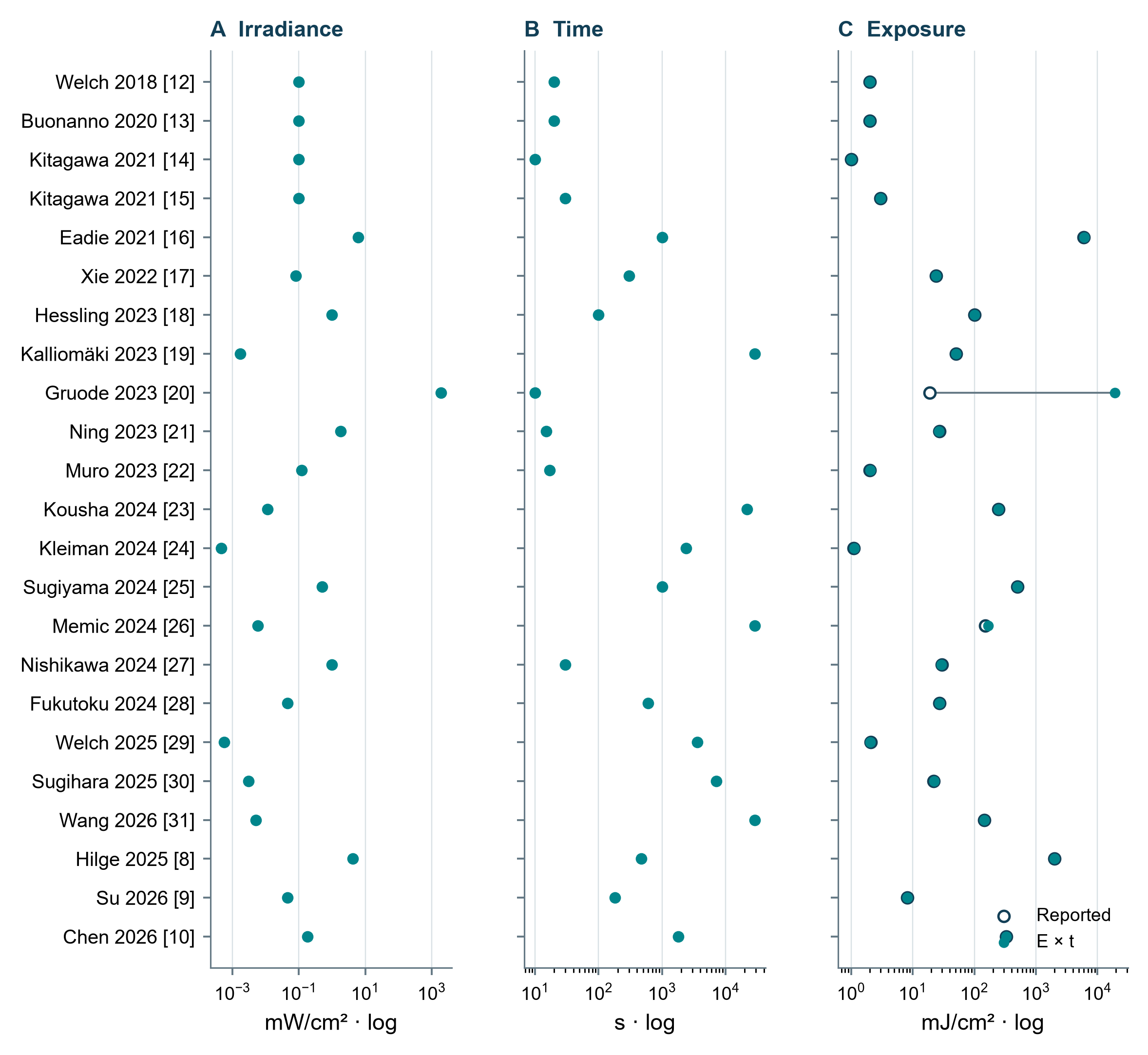
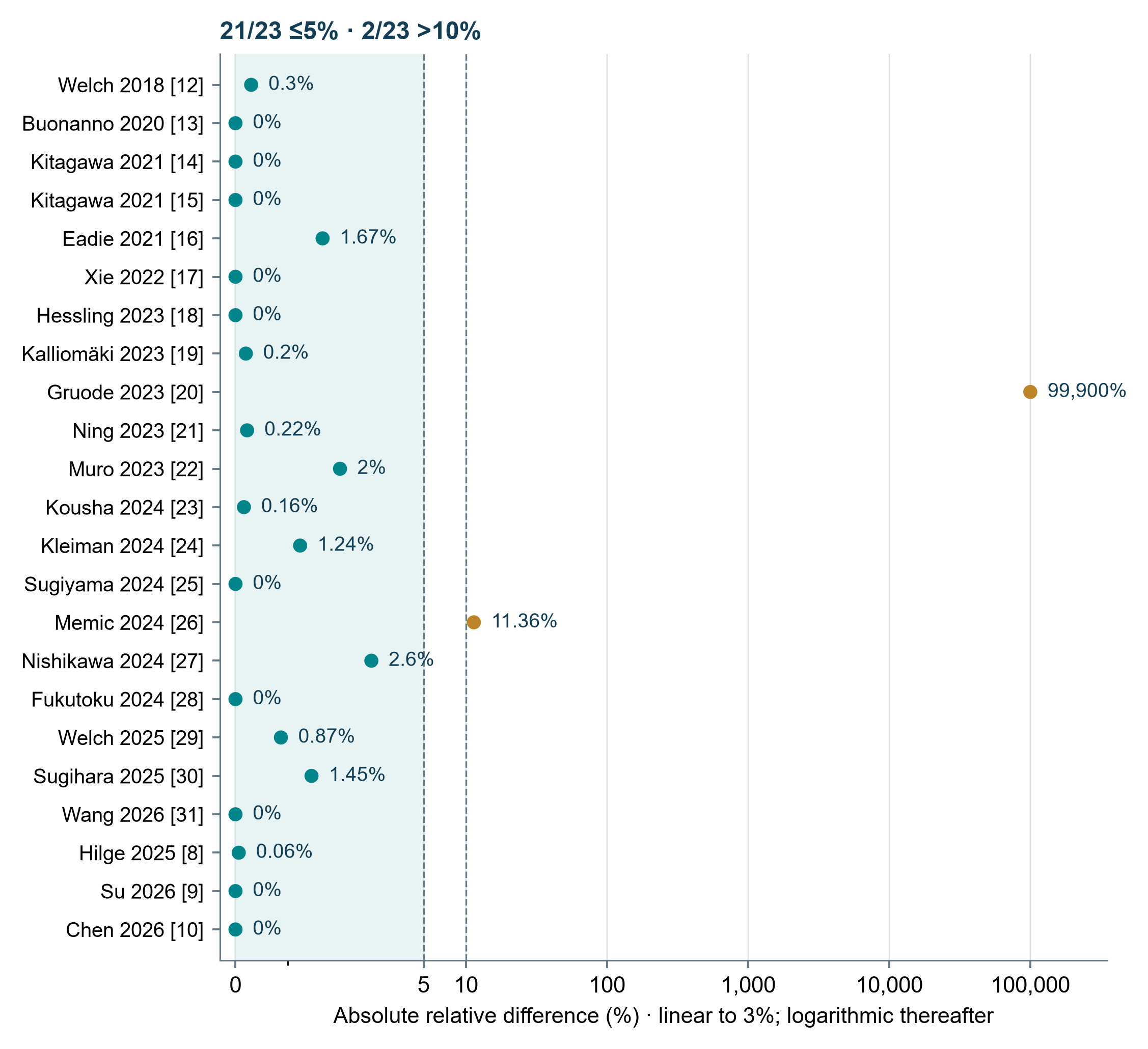
Dosimetric reconstruction was evaluable in 23 of the 84 reports. Twenty-one schedules agreed within 5% and two showed discrepancies greater than 10%. Table 2 presents one representative schedule per report, including irradiance, time, reported exposure, recalculated exposure and relative discrepancy. These results are complemented by assessment of the corpus’s metrological documentation.
Corpus composition and reporting completeness
The corpus included 84 reports: 81 peer-reviewed articles, two preprints and one technical report. Mean completeness was 45.7168% (SD 12.2571) and the median was 46.4286% (Q1–Q3 39.2857–53.5714%). Descriptive categories comprised 52 reports with low completeness, 31 moderate and one high. Corpus composition and score distribution are shown in Figures 1 and 2; item-level results are shown in Figure 3.
| Domain | Mean % | SD |
|---|---|---|
| Source/spectrum | 65.67 | 17.03 |
| Radiometry/calibration | 15.67 | 14.49 |
| Geometry/field | 39.68 | 25.86 |
| Exposure arithmetic | 44.25 | 24.06 |
| Experimental context | 73.91 | 18.96 |
| Report | E (mW/cm²) | t (s) | Reported H (mJ/cm²) | Recalculated H (mJ/cm²) | Difference (%) |
|---|---|---|---|---|---|
| David Welch (2018) [12] | 0.0997 | 20 | 2 | 1.994 | 0.3 |
| Manuela Buonanno (2020) [13] | 0.1 | 20 | 2 | 2 | 0 |
| Hiroki Kitagawa (2021) [14] | 0.1 | 10 | 1 | 1 | 0 |
| Hiroki Kitagawa (2021) [15] | 0.1 | 30 | 3 | 3 | 0 |
| Ewan Eadie (2021) [16] | 6.1 | 1000 | 6000 | 6100 | 1.67 |
| Ruijie Xie (2022) [17] | 0.08 | 300 | 24 | 24 | 0 |
| Martin Hessling (2023) [18] | 1 | 100 | 100 | 100 | 0 |
| Petri Kalliomäki (2023) [19] | 0.00175 | 28800 | 50.5 | 50.4 | 0.2 |
| Jurate Gruode (2023) [20] | 1900 | 10 | 19 | 19000 | 99900 |
| Peiyong Ning (2023) [21] | 1.796 | 15 | 27 | 26.94 | 0.22 |
| Marilena Aquino de Muro (2023) [22] | 0.12 | 17 | 2 | 2.04 | 2 |
| Obaid Kousha (2024) [23] | 0.0115 | 21600 | 248 | 248.4 | 0.16 |
| Norman J. Kleiman (2024) [24] | 0.000464 | 2400 | 1.1 | 1.1136 | 1.24 |
| Kosuke Sugiyama (2024) [25] | 0.5 | 1000 | 500 | 500 | 0 |
| Samir Memic (2024) [26] | 0.0058 | 28800 | 150 | 167.04 | 11.36 |
| Jun Nishikawa (2024) [27] | 0.974 | 30 | 30 | 29.22 | 2.6 |
| Yukari Fukutoku (2024) [28] | 0.045 | 600 | 27 | 27 | 0 |
| David Welch (2025) [29] | 0.00057 | 3600 | 2.07 | 2.052 | 0.87 |
| Kazunobu Sugihara (2025) [30] | 0.0031 | 7200 | 22 | 22.32 | 1.45 |
| X. Wang (2026) [31] | 0.005 | 28800 | 144 | 144 | 0 |
| Felix Hilge (2025) [8] | 4.28 | 467 | 2000 | 1998.76 | 0.06 |
| X.W. Su (2026) [9] | 0.045 | 180 | 8.1 | 8.1 | 0 |
| Kunyu Chen (2026) [10] | 0.183 | 1800 | 329.4 | 329.4 | 0 |
H = E × t. Difference = 100 × |reported H − recalculated H|/|reported H|. One representative schedule is shown per report; other schedules from the same study are retained in the study materials. For Gruode (2023), E = 1,900 mW/cm² is the literal conversion of the printed 1.90 W/cm²: the row exposes the unit inconsistency and does not correct it by inference. The values describe arithmetic reconstruction of the publication, not a new measurement of physical exposure.
Welch and colleagues provide an example of agreement: 0.0997 mW/cm² × 20 s = 1.994 mJ/cm² against a reported 2 mJ/cm²; the difference calculated from these printed values is 0.30%. In Memic and colleagues, the 3-m schedule gives 0.0058 mW/cm² × 28,800 s = 167.04 mJ/cm² against 150 mJ/cm² (11.36%). The 2-m schedule, documented separately in the same source, gives 0.0094 × 28,800 = 270.72 mJ/cm² against 230 mJ/cm² (17.70%). In Gruode and colleagues, the W/cm² unit printed in Methods and the dose table differ by a factor of 1,000 in the reconstructed example; this discrepancy is retained without assigning an inferred corrected unit to the original measurement. [12,26,20]
The examples retain the source, instrument and geometry described in their publications. Welch (2018) used three KrCl excimer lamps with bandpass filters and checked the spectrum with an SPM-002-BT64 calibrated against a deuterium lamp with NIST-traceable spectral irradiance. Memic (2024) measured irradiance with a UIT2400 for 222 nm (Ushio America) at 1, 2 and 3 m. Gruode (2023) used three sample levels at 15, 30 and 45 cm from the source. These conditions are retained when interpreting each report’s calculations. [12,26,20]
B4 applies to 70 reports (14 NA). The mean using the fixed denominator of 28 was 45.4932%. HF06-0559 and HF06-0626 met the joint basic-reporting criterion; no report met the traceability criterion. Zeros for S6 and M5 indicate absence of explicit evidence under the operational definition, not universal absence of the practice.
Arithmetic and temporal exploration
Of the 23 evaluable exposure schemes, 21 agreed arithmetically within 5%; HF06-0858 and HF06-0927 had differences exceeding 10%. Four additional unit or dimensional discrepancies were identified and recorded separately. Temporal exploration showed no clear monotonic association between completeness and publication year (Spearman ρ = −0.138; p = 0.210).


Figures 4 and 5 present the irradiance, time and exposure parameters of the 23 reconstructible schedules and the magnitude of their arithmetic differences.
Discussion
Reconstruction converts irradiance, time and exposure values into comparisons that readers can verify. Agreement in 21 schedules shows that their E × t products reproduce the stated values within the defined tolerance. The two major discrepancies distinguish a numerical disagreement from a unit inconsistency. Interpretation retains each report’s measurement plane and conditions; an agreeing arithmetic product does not by itself establish detector calibration or exposure received by another target.
Main findings
Across the 84 reports, descriptions of the source and experiment were more frequent than information needed to reconstruct a metrologically traceable exposure. The median report met 46.4% of applicable FDRI-28 items, and radiometry/calibration was the least complete domain. No report combined instrument identity, calibration, traceability and uncertainty in the corrected matrix. The result concerns explicit presence of information under the documentary rules applied.
FDRI-28 records presence of reporting elements: a zero indicates that no explicit evidence was located, and a one indicates that the element was documented. This definition keeps documentary completeness separate from experimental implementation. The instrument is exploratory and does not measure risk of bias, efficacy, safety or compliance with exposure limits.
Arithmetic consistency and measurement traceability
Among the 23 evaluable schemes, 21 were arithmetically consistent within 5%. However, approximately 73% of the corpus did not supply a linked exposure scheme permitting this check. Agreement of H = E × t describes calculation consistency; its interpretation also depends on spectral mismatch, calibration, measurement-plane location, field uniformity, reflections, shadows and source stability. The low frequency of items M3–M6 and E5 identifies the least documented metrological components.
The language of units and dimensions also matters. Calling power per area 'fluence', using energy per area when irradiance is intended, or printing W/cm² when a table implies mW/cm² can cause errors in replication, evidence synthesis and implementation. Recording these problems separately from arithmetic agreement preserves the distinction between a computational discrepancy and a measurement-definition problem.
Minimum reporting set for 222-nm studies
Observed gaps support a concise minimum set that can be reported in Methods, a structured exposure table or supplementary material:
1. Source and spectrum: exact wavelength, physical source type, manufacturer/model, filter status, measured spectrum and numerical out-of-band emission.
2. Measurement chain: radiometer or detector brand/model, relevant spectral responsivity, calibration method and date/certificate, traceability chain, source-specific mismatch correction where appropriate, and uncertainty.
3. Geometry and field: source–target distance, angle/orientation, field or aperture dimensions, uniformity or spatial map, measurement position relative to the target plane, and reflection/shadow/boundary conditions.
4. Exposure scheme: numerical irradiance, duration, radiant exposure, continuous/intermittent/pulsed operation, warm-up or stability checks, and at least one locally linked E–t–H example.
5. Context: target or matrix, relevant environmental and biological conditions, replication or sample size, and whether the reported quantity is incident, absorbed, effective/weighted or target-plane.
This set does not prescribe a particular instrument or exposure. It enables examination of the measurement model and its uncertainty.
Implications for research and editorial practice
Dose–response comparison assumes that exposure quantities are physically comparable. Incomplete reporting of spectrum, geometry and metrology can create hidden heterogeneity that conventional evidence synthesis might misclassify as biological variation. The problem is particularly relevant when transferring laboratory exposures to occupied spaces, where reflection, shadow, source distribution, time-varying output and target location can produce very different human, microbial and environmental exposures [6,7].
The 28 items organise source, measurement, geometry, exposure and context components. Exposure reconstruction, calibration and geometric description enable dosimetric reporting to be examined. Exploratory use of FDRI-28 and its validation status are considered under Scope and limitations.
Scope and limitations
Frequencies describe the 84 reports in the selected corpus. Retrospective reconstruction, absence of original exports and the 1,233 supplementary records without complete human screening limit representativeness of the wider literature. HF06-0993 shares content with two included articles, so report-level deduplication does not remove all documentary dependence.
FDRI-28 was applied as an exploratory documentary-completeness instrument, with definitions and scores reviewed by two assessors. The analysis did not estimate inter-rater reliability, construct validity or association with external outcomes. Binary scoring summarises the presence of information and may omit differences in detail between experimental arms. Fixed-denominator sensitivity using 28 yielded almost identical results. Arithmetic consistency concerns published values and does not constitute calibration of the original measurements.
Year-based comparisons were retrospective and unadjusted, with changes in corpus composition and incomplete 2026 coverage. They are interpreted as temporal descriptions of the available reports.
Conclusions
The audit reconstructed one exposure schedule from 23 reports on 222-nm far-UVC: 21 agreed within 5% and two showed discrepancies greater than 10%. Presenting irradiance, time, reported exposure and recalculated exposure together makes these differences locatable and reproducible, including a factor-of-1,000 discrepancy associated with the printed units.
Mean reporting completeness was 45.72%, with the lowest proportion in radiometry/calibration (15.67%). Two reports met the joint basic-reporting criterion and none met the traceability criterion. The contribution integrates exposure reconstruction and metrological assessment of reporting: linked values permit calculations to be checked, while spectrum, instrument, calibration, geometry and uncertainty define how the measurement can be interpreted.
Disclosures
Ethics approval and consent
Not applicable. This systematic review and metascientific audit used published reports, public or supplied for analysis. It collected no individual data, contacted no participants and accessed no private identifiable information. No new human or animal intervention was performed.
Patient and public involvement
Patients and members of the public were not involved in the design, conduct, interpretation or reporting of this audit. The work evaluates reporting in published documents.
Protocol, registration and analysis plan
The protocol and statistical plan dated 17 August 2026 retrospectively document reconstruction of the v1.2 package. They were neither prespecified nor prospectively registered. Live API queries are retained as search reconstruction and distinguished from the original historical exports.
Data, code and material availability
The reproducible HF06 v2.9 material contains the corpus, FDRI-28 matrix, item definitions, extraction evidence, irradiance–time–exposure values and analysis code. The programs run_reproduce.py and validate_outputs.py reproduce scores, summaries and arithmetic checks. Full-text distribution follows each source’s permissions.
Funding and sponsor role
The work received internal research funding from MedETechni SpA, with which the authors are affiliated. There was no external funding. The institutional and financial relationship is disclosed under Conflicts of interest and editorial independence.
Conflicts of interest and editorial independence
Kevin Virgilio Morales Chamorro is founder and Chief Executive Officer of MedETechni SpA, developer and marketer of 222-nm far-UVC technologies including Virgilio Rays. Gricell Jeraldina Báez Arévalo is Chief Medical Officer of MedETechni SpA. MedETechni SpA funded the work and publishes MedETechni Journal of Translational Research. These institutional, financial, commercial and editorial interests are disclosed.
Author contributions
CRediT contribution distribution. Kevin Virgilio Morales Chamorro: conceptualisation, methodology, software, formal analysis, investigation, data curation, resources, visualisation, original draft, supervision, project administration and funding acquisition. Gricell Jeraldina Báez Arévalo: methodology, investigation, and review and editing of the text.
AI-assisted work statement
Generative artificial intelligence based on a language model, through Codex (OpenAI; GPT-6.1 Sol model), was used for text retrieval and normalisation, evidence location, application of extraction rules, calculations and writing. Decisions retain their sources and locators. Two reviewers checked scores and corpus selection. The authors retain scientific responsibility for interpretation and final content.
References
31- Page MJ, McKenzie JE, Bossuyt PM, Boutron I, Hoffmann TC, Mulrow CD, et al. The PRISMA 2020 statement: an updated guideline for reporting systematic reviews. BMJ. 2021;372:n71. doi:10.1136/bmj.n71.
- Rethlefsen ML, Kirtley S, Waffenschmidt S, Ayala AP, Moher D, Page MJ, et al. PRISMA-S: an extension to the PRISMA Statement for Reporting Literature Searches in Systematic Reviews. Syst Rev. 2021;10(1):39. doi:10.1186/s13643-020-01542-z.
- Commission Internationale de l’Éclairage. Characterization and Calibration Methods of UV Radiometers. CIE 220:2016. Viena: CIE; 2016. ISBN 978-3-902842-07-7. Disponible en: https://cie.co.at/publications/characterization-and-calibration-methods-uv-radiometers.
- Larason TC, Cromer CL. Sources of error in UV radiation measurements. J Res Natl Inst Stand Technol. 2001;106(4):649–656. doi:10.6028/jres.106.030.
- Iwasa Y, Kinoshita K, Shitomi H. Spectral Mismatch Effect of Ultraviolet Radiometers in Actual UV-C Measurement. Photochem Photobiol. 2023;99(5):1240–1247. doi:10.1111/php.13765.
- Claus H, Cooksey CC. Reflectance measurements of building materials in the Far UVC (222 nm) wavelength range. Proc SPIE. 2022;12201:1220106. doi:10.1117/12.2633541.
- Link MF, Shore A, Robertson R, Hamadani BH, Poppendieck D. Spectral characteristics and indoor air quality effects of germicidal 254 nm and 222 nm ultraviolet light. Gaithersburg (MD): National Institute of Standards and Technology; 2024. NIST IR 8550. doi:10.6028/NIST.IR.8550.
- Hilge F, Wang-Evers M, Buhl L, Downs H, Dolling M, Pohl L, et al. Label-free visualization and quantitative analysis of Far UV-C skin safety with dynamic optical coherence tomography with subcellular resolution. Biomed Opt Express. 2025;16(9):3682–3701. doi:10.1364/BOE.569995.
- Su XW, Tan GYA, Ceesay K, Li WS, Lai ACK. Far-UVC and UVC disinfection of healthcare fabrics: from laboratory evidence to clinical application. Results Eng. 2026;32:113174. doi:10.1016/j.rineng.2026.113174. Versión evaluada: preprueba editorial.
- Chen K, Sun Z, Huang J, Huang X, Li P, Jin Y, et al. Cascading purification of algal-laden surface water by Far-UVC/Fe(VI)-UF: Overcoming the organic matter transformation-water quality risk trade-off. Water Res. 2027;308(Pt B):126976. doi:10.1016/j.watres.2026.126976. Publicado en línea el 16 de septiembre de 2026; versión evaluada: preprueba editorial.
- Sheng X, Qian J, Zhang Q, Zeb A, Zhao L, Zhang J, et al. Application of cold plasma combined with far ultraviolet: A technique for microbial inactivation and quality improvement of cherry tomatoes. J Future Foods. 2026 sep. Publicación anticipada en línea. doi:10.1016/j.jfutfo.2026.09.027.
- David Welch et al. Far-UVC light: A new tool to control the spread of airborne-mediated microbial diseases. Scientific reports. 2018. doi:10.1038/s41598-018-21058-w.
- Manuela Buonanno et al. Far-UVC light (222 nm) efficiently and safely inactivates airborne human coronaviruses. Scientific reports. 2020. doi:10.1038/s41598-020-67211-2.
- Hiroki Kitagawa et al. Effect of intermittent irradiation and fluence-response of 222 nm ultraviolet light on SARS-CoV-2 contamination. Photodiagnosis and photodynamic therapy. 2021. doi:10.1016/j.pdpdt.2021.102184.
- Hiroki Kitagawa et al. Effectiveness of 222-nm ultraviolet light on disinfecting SARS-CoV-2 surface contamination. American journal of infection control. 2021. doi:10.1016/j.ajic.2020.08.022.
- Ewan Eadie et al. Extreme Exposure to Filtered Far-UVC: A Case Study†. Photochemistry and photobiology. 2021. doi:10.1111/php.13385.
- Ruijie Xie et al. Systematical Investigations on Disinfection Effectiveness of Far-UVC (222 nm) irradiation: From Laboratory Study to Field Tests Journal of Applied & Environmental Microbiology. 2022. doi:10.12691/jaem-10-1-3.
- Martin Hessling et al. Far-UVC Radiation for Disinfecting Hands or Gloves? Pathogens (Basel, Switzerland). 2023. doi:10.3390/pathogens12020213.
- Petri Kalliomäki et al. Ozone and ultra-fine particle concentrations in a hotel quarantine facility during 222 nm far-UVC air disinfection medRxiv. 2023. doi:10.1101/2023.09.29.23296366.
- Jurate Gruode et al. RT-qPCR-Based Assessment of the Efficacy of 222 nm UVC Irradiation in Reducing SARS-CoV-2 Surface Contamination. Sensors (Basel, Switzerland). 2023. doi:10.3390/s23136129.
- Peiyong Ning et al. Study on disinfection effect of a 222-nm UVC excimer lamp on object surface. AMB Express. 2023. doi:10.1186/s13568-023-01611-1.
- Marilena Aquino de Muro et al. The abundance of the potential pathogen Staphylococcus hominis in the air microbiome in a dental clinic and its susceptibility to far-UVC light. MicrobiologyOpen. 2023. doi:10.1002/mbo3.1348.
- Obaid Kousha et al. 222 nm Far-UVC from filtered Krypton-Chloride excimer lamps does not cause eye irritation when deployed in a simulated office environment. Photochemistry and photobiology. 2024. doi:10.1111/php.13805.
- Norman J. Kleiman et al. 222 nm far-UVC light markedly reduces the level of infectious airborne virus in an occupied room. Scientific reports. 2024. doi:10.1038/s41598-024-57441-z.
- Kosuke Sugiyama et al. Bactericidal effect of far ultraviolet-C irradiation at 222 nm against bacterial peritonitis. PloS one. 2024. doi:10.1371/journal.pone.0311552.
- Samir Memic et al. Evaluation of an Automated Wall-mounted Far Ultraviolet-C Light Technology for Continuous or Intermittent Decontamination of Candida auris on Surfaces Pathogens and Immunity. 2024. doi:10.20411/pai.v9i1.683.
- Jun Nishikawa et al. Far-Ultraviolet Light at 222 nm Affects Membrane Integrity in Monolayered DLD1 Colon Cancer Cells. International journal of molecular sciences. 2024. doi:10.3390/ijms25137051.
- Yukari Fukutoku et al. The new 222-nm far ultraviolet-C lowers bacterial contamination to endoscopists during esophagogastroduodenoscopy. DEN open. 2024. doi:10.1002/deo2.292.
- David Welch et al. Film dosimetry for occupant exposure monitoring within Far-UVC installations. Photochemistry and photobiology. 2025. doi:10.1111/php.13960.
- Kazunobu Sugihara et al. Interventional human ocular safety experiments for 222-nm far-ultraviolet-C lamp irradiation. Photochemistry and photobiology. 2025. doi:10.1111/php.14016.
- X. Wang et al. Effectiveness of 222 nm far-UVC disinfection of airborne and surface bioaerosols in railway trains Building Simulation. 2026. doi:10.1007/s12273-026-1480-6.
Cite this article
Kevin Virgilio Morales Chamorro; Gricell Jeraldina Báez Arévalo. Reporting quality and metrological traceability of 222-nm far-UVC dosimetry: a systematic review and metascientific audit. MedETechni Journal of Translational Research. 2026;1:e0003-en. https://doi.org/10.68897/mjtr.2026.e0003.en
RIS for Zotero, Mendeley and EndNote. Exports cite this English translation; the Spanish DOI is retained only by the original.Publication files and materials
Keep the complete article, its figures and metadata for reading and citation.
The package includes ES/EN full texts, both PDFs, figures, metadata, references and a SHA-256 manifest. This is a publication archive; primary research data and research supplements follow the article’s data-availability statement.Enquire about this study’s data or supplementsHistory and versions
- Spanish original published
- Title updated
- HTML full text and English translation
- English PDF and publication archive
- Dosimetric reconstruction and results revised
The dosimetric reconstruction of 23 reports is made explicit, with irradiance, time, reported and recalculated exposure, unit checks, and source, instrument and geometry examples. Corpus reporting results are retained and references supporting the reconstructed schedules are expanded.
Read the Spanish PDF
This PDF corresponds to the Spanish version available on this page. The English translation is available as a separate download.