
Microbial inactivation by 222-nm far-UVC: a systematic review and dose-response synthesis in air, water, surfaces and biofilms
Inactivación microbiana por far-UVC a 222 nm: revisión sistemática y síntesis de dosis-respuesta en aire, agua, superficies y biopelículas
MedETechni, Santiago, Chile
Original published · English translation
English translation of the Spanish original, prepared by the journal with AI assistance and checked for text, numbers, tables and references. Disclosures and manuscript-approval statements translated below concern the original study. Figures retain their original labels; captions and tables are translated.
Abstract
Background. Published 222-nm far-UVC efficacy values span orders of magnitude, but differences in exposure matrix, microbial state, dose measurement, shouldering, and tailing are often collapsed into a single "susceptibility" value. This systematic review mapped the evidence and assessed whether a pooled D90 could be estimated.
Methods. Retrospective systematic review of a selected corpus. We extended an initial 81-report dosimetry dataset and a 19-report targeted update with full texts recovered on 2 October 2026. Eligibility required a separable nominal 222±2 nm arm and viable microbial/infectivity outcome. Su and Sheng were included; Chen remained contextual and Liu a secondary review. D90 preserved model-specific logarithmic bases and full curves. Alternative Sheng fits were retained for sensitivity. Selection and extraction were AI-assisted and ratified by two reviewers.
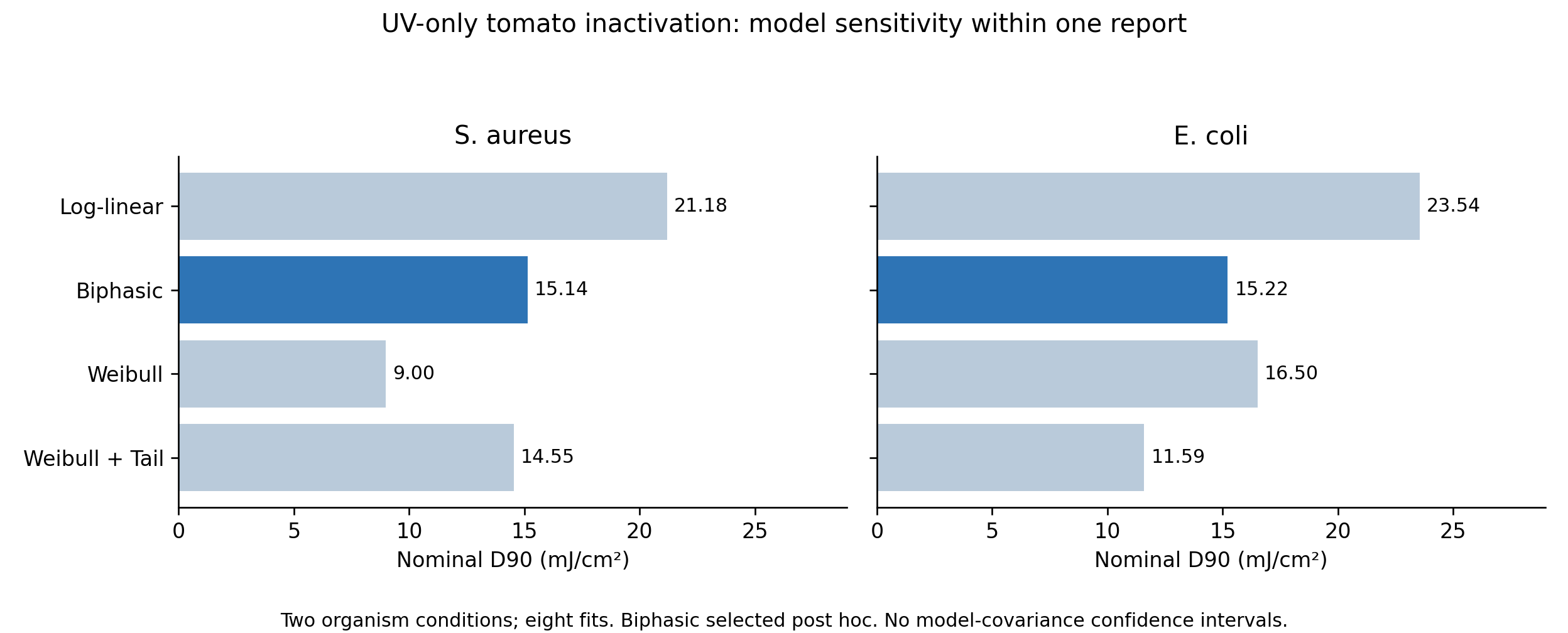
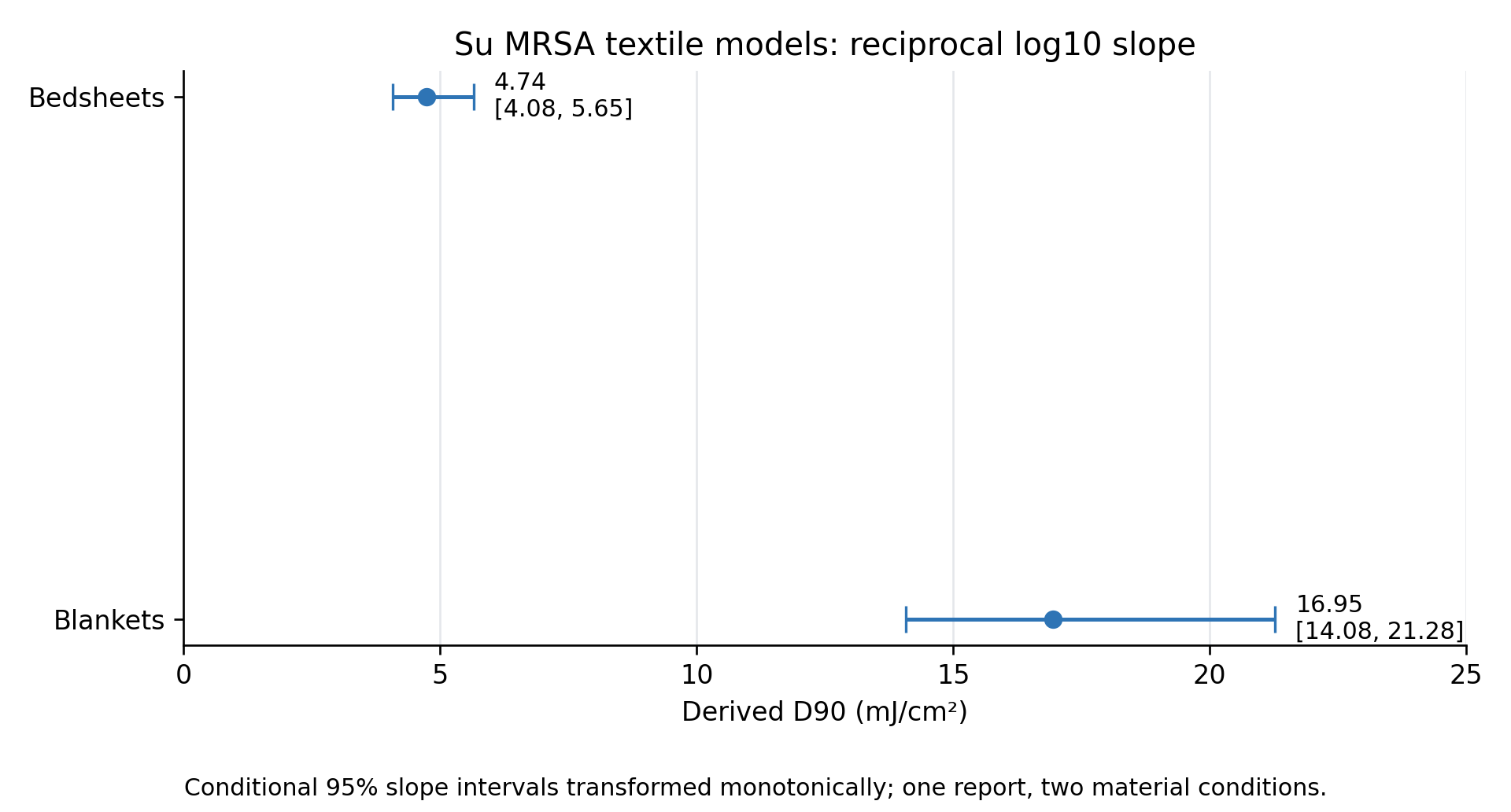
Results. The integrated map contains 103 reports, 63 inclusions and 51 D90 conditions from six reports. The 57 model estimates include four alternate fits per organism in Sheng, not eight independent conditions. Su MRSA slopes yield D90 4.74 mJ/cm² (conditional transformed 95% CI 4.08–5.65) on bedsheets and 16.95 (14.08–21.28) on blankets. Sheng UV-only biphasic fits yield nominal D90 15.14 and 15.22 mJ/cm² for S. aureus and E. coli, without recoverable model covariance. The baseline McDonald complete model yields 8.30 mJ/cm² versus 1.86 for slope alone; four Petersen D90 targets remain unattainable under fitted plateaus. No coherent stratum met the meta-analysis criterion.
Conclusions. Preserving the complete curve changed D90 from 1.86 to 8.30 mJ/cm² for McDonald and identified four unattainable targets for Petersen. The synthesis explains differences between estimates through matrix- and model-specific comparisons; it does not establish a universal dose or clinical efficacy.
Key points
Question. Is it defensible to combine 222-nm far-UVC dose–response estimates across different microorganisms, matrices and models?
Findings. The map contains 103 reports, 63 inclusions and 51 quantitative conditions from six reports; the 57 model estimates retain their clustering. No stratum met the meta-analysis rule.
Meaning. Retaining matrix, model and experimental unit allows compatible estimates to be compared and identifies when an aggregate D90 lacks a physical or statistical basis.
Plain-language summary
Results for 222-nanometre light vary with the microorganism, material and response-analysis model. This systematic review organises experimental conditions and shows that retaining complete curves changes some estimates. Its contribution is to explain these differences through reproducible calculations, rather than assign a single dose to different situations. Results describe experimental inactivation and do not assess wound healing or human safety.
Introduction
Krypton–chlorine excimer sources emitting mainly at 222 nm are being investigated as continuous or intermittent microbial controls. The literature includes bacteria, viruses, fungi and spores in bench experiments, chambers, occupied rooms, transport and clinical areas. These results do not, however, constitute a single physical population: radiation reaches virions, vegetative cells, spores, droplets, dried deposits, suspensions and biofilms with differing absorption, shielding, aggregation, repair and recovery. [4–12,15,19–22,26,27]
In a log-linear model S(D)=exp(−kD), D90=ln(10)/k. That identity no longer represents the total dose from D=0 when a shoulder is present and may substantially underestimate dose when survival is biexponential. If the fitted resistant fraction is at least 0.10 and k2=0 is fixed, a one-log reduction is not even identifiable within the model.
This systematic review organises evidence by taxon and matrix and incorporates dosimetric quality and nonlinear kinetics. Separate analysis of biofilms and physically compatible estimates examines differences that are lost when heterogeneous conditions are pooled.
Methods
Design and protocol timing
A retrospective systematic review of a selected corpus, with an evidence map, quantitative synthesis and SWiM reporting without meta-analysis. The protocol dated 2 September 2026 was documented after the 81-report seed was known. The analysed cycle and October search had no prospective registration; their exports were retained in the study record. [1-3]
Eligibility, sources and selection
Primary studies with a nominal peak source of 222±2 nm and interpretable viable reduction or infectivity were included. Arms at 207, 233, 254 or 275 nm were excluded from the primary synthesis unless a separable 222-nm arm existed. The first cycle incorporated the 81 HF06 reports and 19 historical or update records: 46 and 15 were eligible, respectively, with 35 and four exclusions. October retrieval added Su and Sheng as primary inclusions and Chen as context: 103 reports, 63 inclusions and 40 exclusions or contextual records. Liu was already in E016 and was not counted again. The search began from a known seed. Two reviewers ratified selection and checking of the 51 conditions and 57 estimates against their sources, including Su and Sheng.
Extraction and harmonisation
The schema records microorganism, matrix, inoculum, dosimetry, viability assay, detection limit, model, constants, uncertainty and D90. Unavailable fields remain empty. Conditions from the same article were not treated as independent studies.
Log-linear. D90=ln(10)/k for a natural-log k; D90=1/k if the slope is on the log10 scale.
With a shoulder. ln(10)/k describes the linear segment; the shoulder is added only if the published parameterisation permits it.
Biexponential. S(D)=(1−f)exp(−k1D)+f exp(−k2D)=0.10 was solved. If k2=0 and f≥0.10, D90 was declared non-identifiable.
Endpoint conversion. The directly published D90 takes priority. D99.9/3 is an alternative approximation compatible only with a log-linear model; this approximation was not used for the Buonanno estimates.
Censoring. Values below the detection limit were not converted into exact numbers.
Meta-analysis rule and quality
The synthesis rule specified log(D90), REML and Hartung–Knapp intervals, with a multilevel structure or robust variance for conditions clustered by study. The rule required at least three independent studies per matrix–organism stratum. No current stratum met that rule. Quality assessment considers spectrum and filtering, calibration, geometry and corrections, replication, viability and detection limit, controls, dose/model coverage and conflicts.
Source and model update
The supplementary search collected 27,570 records and 21,904 deduplicated candidates, retained as a discovery archive separate from the evaluated corpus. The earlier PubMed and Europe PMC search contained 4,850 entries. Adding three reports brought the map to 103 reports, with 63 inclusions and 40 exclusions or contextual records; Liu was already listed as a secondary review. Versions and fingerprints of the four retrieved PDFs were archived. On 7 October 2026, the full text of Welch [28] was retrieved and retained as context without new D90 conditions. Eleven baseline full texts remained inaccessible after documented attempts and were excluded from the quantitative synthesis without imputation of results. Su and Sheng were analysed as journal pre-proofs. Chen was ordered by its online availability on 16 September 2026 and retained 2027 as the volume year.
Buonanno publishes D90 values of 0.56 and 0.39 mJ/cm² for HCoV-229E and OC43. The k values are 4.1 (95% CI 2.5–4.8) and 5.9 (3.8–7.1) cm²/mJ. Transforming the limits through ln(10)/k yields 0.480–0.921 and 0.324–0.606 mJ/cm². These intervals transform the CIs for k; they are not independent uncertainty estimates for the rounded D90 values. [8]
The complete McDonald model (equation 4 and S1 Table) uses k=1.24, shoulder=6.82, log10 residual fraction=−6.25 and log10 initial fraction=−0.14. Its D90 for N/N0=0.10 is 8.297 mJ/cm². Normalising to the fitted intercept of 0.7244 gives a relative dose of 8.592. The sum shoulder+ln(10)/k=8.677 and slope-derived dose=1.857 are different approximations. A CI for the published fit is not calculated without its covariance. The retrieved 222-nm experimental dataset (maximum 42.848 mJ/cm²) incorporated the corrected standard error of 0.17 from S1 E4. A separate unweighted fit with conditional covariance was performed; it does not reconstruct biological clustering or count censoring. [17]
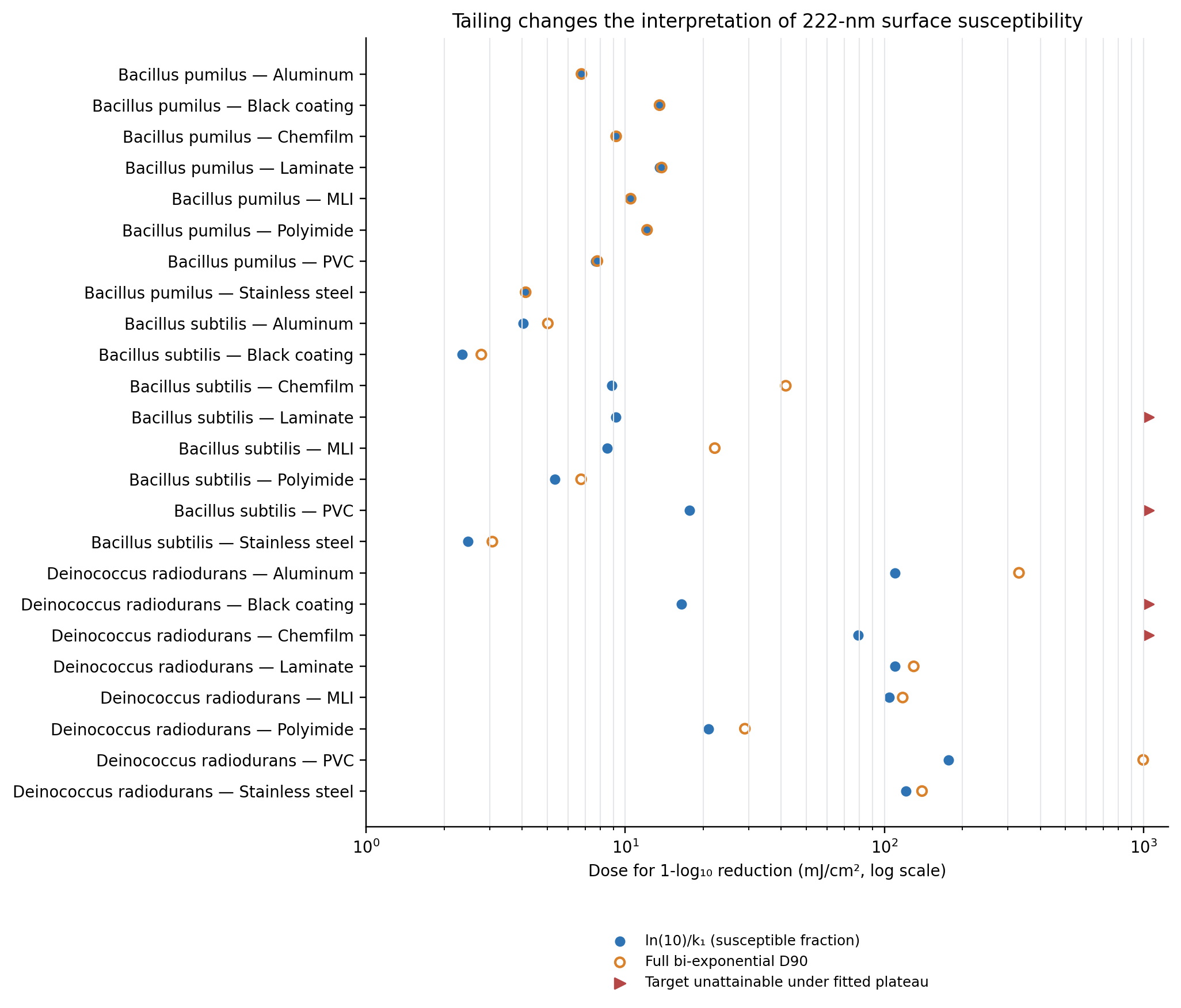
For Petersen, Table 1 is retained where it conflicts with the prose; three aluminium conditions reuse earlier data. Excluding aluminium yields finite median D90 values of 10.488, 6.753 and 129.853 for B. pumilus, B. subtilis and D. radiodurans. 20 finite and four unattainable D90 values were reproduced; for D99, 15 were finite and nine unattainable. Table S1 allows maximum dose to be recovered for 21 new conditions: B. pumilus 600 mJ/cm² (stainless steel 500), B. subtilis 50 and D. radiodurans 800. The 2024 original archived by NASA supplies aluminium maxima of 300 for B. pumilus and 800 for D. radiodurans; the B. subtilis maximum remains unknown. Maxima are available for 23 of 24 conditions. Solutions beyond the range are marked as extrapolations; covariance remains unavailable. High values, including 998.07, are point solutions of the model, not validated practical doses. [23,31]
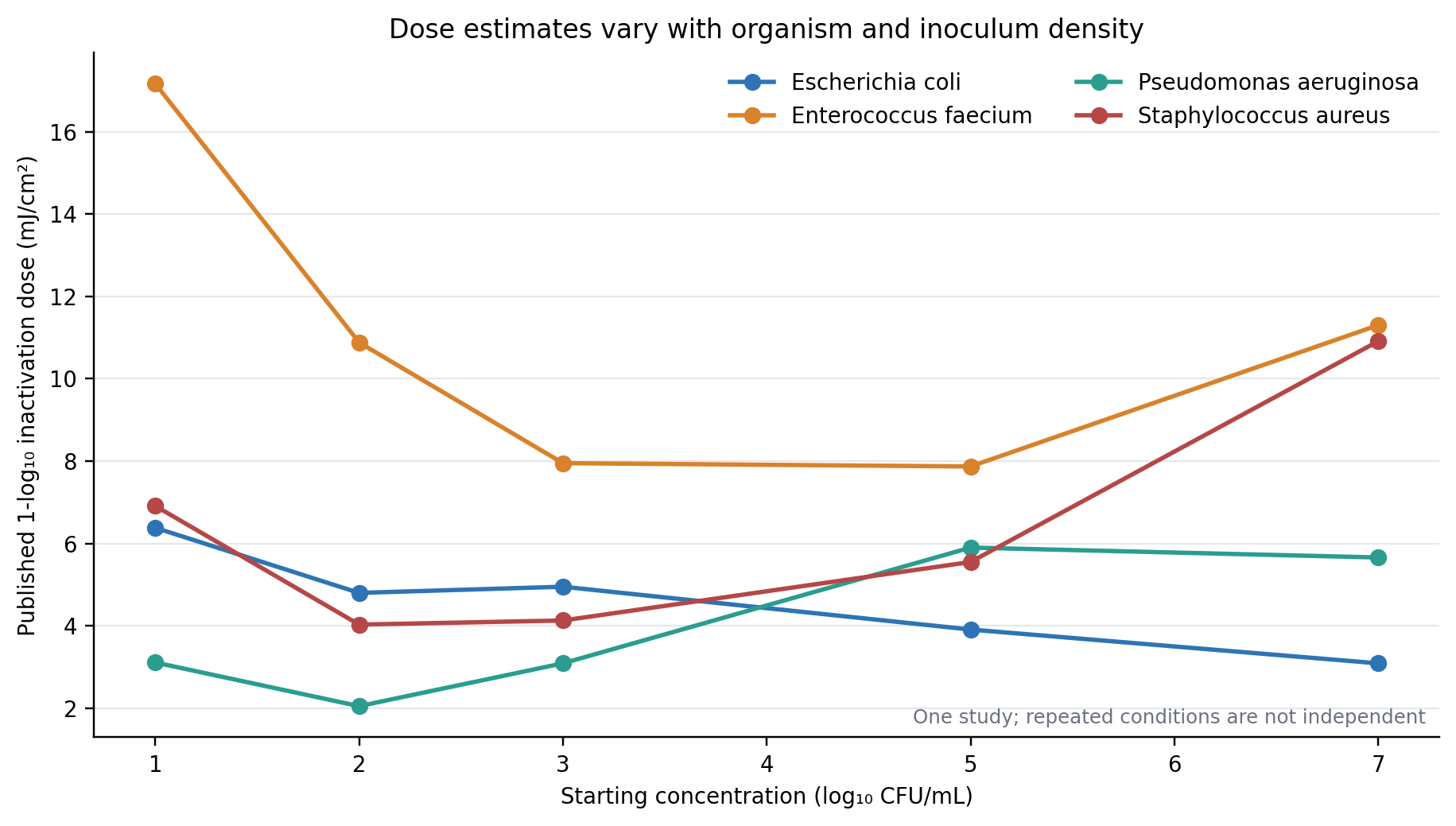
Griffin's Table 3 supplies 20 organism–density conditions; 1LogID is an endpoint-derived equivalent, not a D90 fitted to the complete curve. The measured peak is 220.97 nm (nominal 222 nm). The S. aureus mean calculated from the five cells is 6.306 (6.31 rounded), but the source prints 6.30. Locators and human-review fields are retained in the traceability record. [16]
Results
Evidence map
The integrated database contains 103 unique reports: 100 baseline and three retrieved in October. 63 are included, and 40 are excluded or retained as context. Liu was already in the database as a secondary review. Retrieval adds two quantitative reports; the broad discovery archive remains outside this corpus. Figure 1 uses 2026 as Chen's online year; its reference retains 2027 as the volume year. These counts describe the selected map, not an exhaustive PRISMA flow.
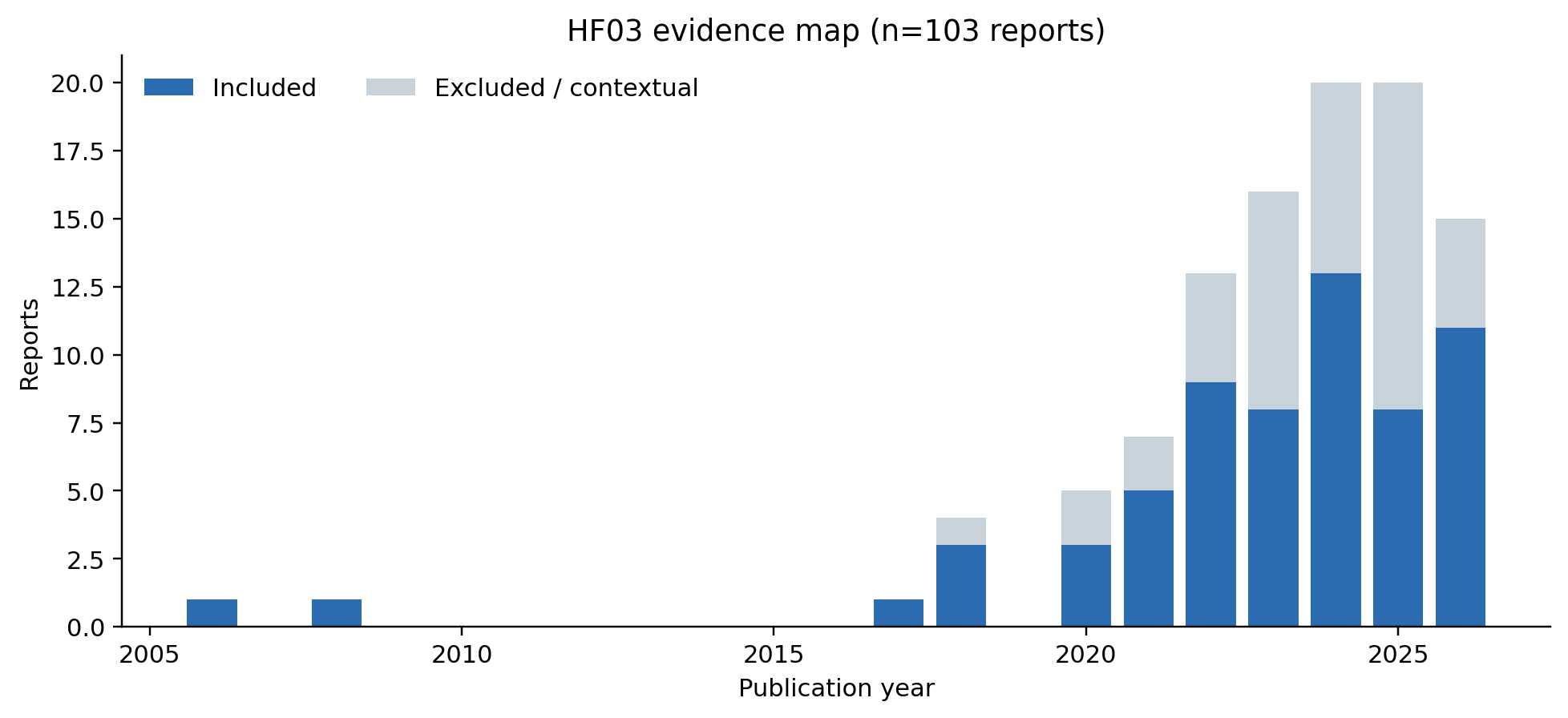
| Layer | n | Interpretation |
|---|---|---|
| Unique reports | 103 | 81 seed + 19 baseline + 3 newly retrieved |
| Included | 63 | Eligibility ratified by two reviewers |
| Excluded or contextual | 40 | Explicit reason in the database |
| Checked quantitative conditions | 51 | Six reports; 57 model estimates |
| Harmonised secondary references | 33 | Context only; no primary meta-analysis |
| Biofilm-focused reports | 3 | Insufficient and heterogeneous for pooling |
Synthesis by matrix and model
| Stratum | Organism | Matrix | D90 or equivalent (mJ/cm²) | Model and scope |
|---|---|---|---|---|
| Airborne enveloped virus | HCoV-229E / OC43 | Aerosol | 0.56 / 0.39 | Directly published D90; 95% CI for k transformed separately |
| Gram-negative bacterium | E. coli K-12 | Water | 1.86 from slope; 8.30 complete model | Geeraerd kmax=1.24±0.08; shoulder=6.82±0.51 |
| Vegetative bacterium | B. subtilis | Dry surfaces | 6.94 initial; 5.89 finite median of complete model | 8 materials; complete D90 non-identifiable in 2/8 |
| Bacterial spore | B. pumilus | Dry surfaces | 9.84 initial; 9.85 median of complete model | 8 materials; complete range 4.13–13.81 |
| Extremophilic bacterium | D. radiodurans | Dry surfaces | 107.15 initial; 134.81 finite median of complete model | 8 materials; finite range 28.95–998.07; 2/8 non-identifiable |
| Gram-positive bacterium | MRSA | Textile sheets | 4.74 (95% CI 4.08–5.65) | Su; log10 slope; conditional CI |
| Gram-positive bacterium | MRSA | Textile blankets | 16.95 (14.08–21.28) | Su; log10 slope; conditional CI |
| Vegetative bacterium | S. aureus ATCC 6538 | Tomato; UV alone | 15.14 nominal | Sheng; biphasic; covariance unavailable |
| Vegetative bacterium | E. coli ATCC 25922 | Tomato; UV alone | 15.22 nominal | Sheng; biphasic; covariance unavailable |
Slope-derived D90 (1.86), the shoulder-plus-slope approximation (8.68) and the complete-model solution (8.30) are different estimands for E. coli in water. The fitted intercept is not fixed at one. For D. radiodurans on surfaces, finite complete-model D90 values reached 998.07 mJ/cm²; two plateaus made a one-log reduction non-identifiable.
Species, inoculum and biofilm
In a single suspension study, mean doses were 4.63±1.23 mJ/cm² for E. coli, 11.03±3.78 for E. faecium, 3.96±1.72 for P. aeruginosa and 6.31±2.83 for S. aureus. Gram-positive conditions averaged 8.67 versus 4.29 mJ/cm², a ratio of 2.02. This is a descriptive within-study comparison, not a general taxonomic estimate. [16]
The three studies directly focused on biofilms differ in species, maturity, matrix, architecture and outcome. They demonstrate destruction or reduction in specific contexts but do not support a universal resistance multiplier. Inoculum composition, saliva, organic burden, drying and material absorption are possible effect modifiers. [13,14,18]
Retrieved evidence on textiles and food
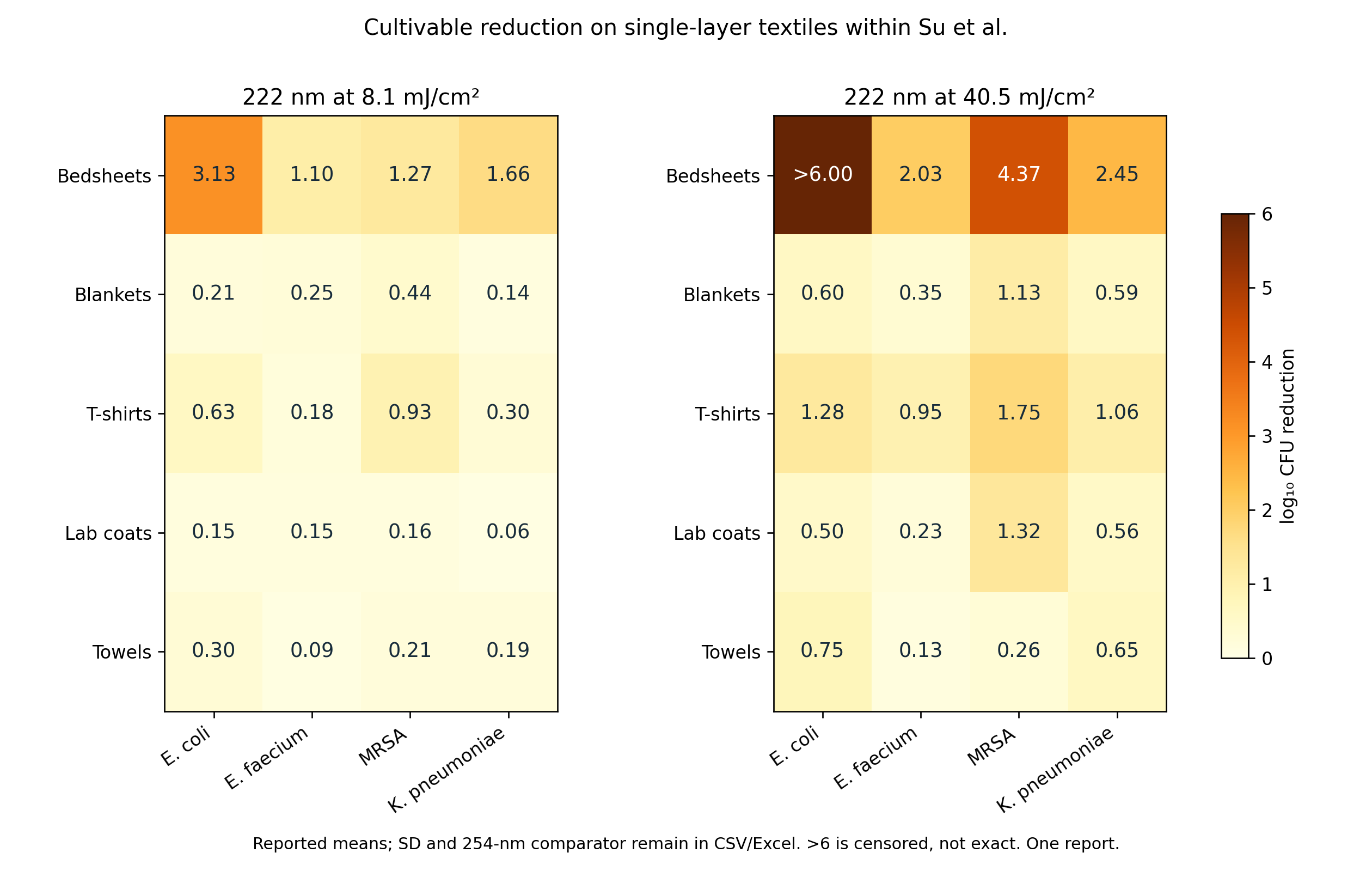
Su et al. [32] compare culturable reduction in four organisms and five textiles at 8.1 and 40.5 mJ/cm². The 40 paired comparisons depend on a single report. At 40.5 mJ/cm², E. coli on sheets shows >6 log10 at 222 nm versus 3.87±0.10 at 254 nm; the bound is retained rather than replaced with exactly 6. Other comparisons favour 254 nm or depend on organism/material. The comparison depends on the organism and material. The ten MRSA observations in lower layers remain supplementary and are not converted to D90.
Su's separate MRSA models for clinical-room coupons are forced through the origin and use a log10 slope: D90=1/k. For sheets, the result is 4.739 mJ/cm², with transformed conditional 95% CI limits of 4.082–5.650; for blankets, 16.949 with 14.085–21.277. The rounded prose/caption slope is used, and the precision difference from the graph (0.2111 and 0.0592) is recorded. Intervals describe the fitted slope without incorporating all dosimetric uncertainty or validating clinical performance.
Sheng et al. [33] include culturable S. aureus and E. coli counts on tomatoes for UV alone, CP and CP+UV separately. With incident irradiance of 0.92±0.05 mW/cm² and 0–150 s, the biphasic UV fits have the best published R2/RMSE and produce nominal D90 values of 15.137 and 15.221 mJ/cm² relative to each model's fitted N0. Selection is descriptive and post hoc. All eight fits are retained as sensitivity analyses of two conditions and do not generate CIs without covariance. Calculated exposure corresponds to incident irradiance; local dose on the curved surface was not determined. Shelf-life and combined-treatment results do not belong to the isolated UV effect.
Contextual and secondary sources
Chen et al. [34] study a far-UVC/Fe(VI)-UF process. Incident irradiance of 0.183 mW/cm² for 30 min corresponds to 329.4 mJ/cm², but the accessible viability/recovery outcome does not establish a separable D90 for UV alone. Combined results remain contextual. The online date of 16 September 2026 and volume year of 2027 are retained.
Liu et al. [24] is a secondary review. Its pooled comparative OR and cellular-damage outcomes are different estimands from HF03's matrix-specific D90 values; they are not reused as a primary experiment, converted to D90 or taken as proof of human safety. 54 references are archived for tracking, distinguishing literal matches from fuzzy candidates. Eligibility and retrieval were evaluated by primary source; the review's references were not incorporated automatically.
Welch et al. [28] assessed culturable bacteria in an occupied dental clinic. The report describes 71 filter samples and 44 impactor samples, collected in different periods, and an estimated combined reduction of 39.5% (95% CI: 19–60%). It is retained as contextual evidence on an environmental system: the 115 samples belong to the same investigation, the outcome is not infection incidence and the reduction is not converted to D90. The observational design and dependence on ventilation and occupancy limit causal inference and clinical extrapolation.
Discussion
The evidence supports microbicidal activity at 222 nm, but not a universal dose. Enveloped coronaviruses in aerosols show high susceptibility under controlled conditions; dry, extremophilic or matrix-protected populations may require doses hundreds of times higher. Some variability is biological, and some arises from how dose is calculated and delivered.
Preserving shoulders and tails is decisive. k1 characterises the initially susceptible fraction, not necessarily the entire population. In applications, the target is usually the entire recoverable burden, so ignoring a resistant fraction can overstate expected efficacy. Reductions in rooms or transport likewise do not equate to intrinsic constants: they depend on flow, occupancy, shadows, distance and residence time.
The Gram-related finding does not establish a universal law. Species, strain, pigments, repair, sporulation, aggregation, medium composition, fluence uniformity and assay recovery may dominate the response. Mechanistic studies from 2025–2026 support protein damage and suppression of repair at 222 nm, but these mechanisms do not eliminate optical shielding. [25]
Methodological contribution and relationship to other studies
This synthesis provides matrix stratification, dosimetric assessment and complete-curve solutions retaining shoulders, tails and experimental clustering. These features complement Griffin's experiment and review, Liu's wavelength comparison, Prismasari and Kang's mechanistic review, and Hessling and colleagues' synthesis on biofilms. The incompatibility of a cross-matrix D90 is a methodological result of the synthesis, accompanied by specific, traceable estimates. [16,24,29,30]
HF03 shares the 81 seed reports and 46 of the 63 current inclusions with HF06. The 47 baseline quantitative conditions come from four reports already indexed in HF06; the four new conditions come from Su and Sheng and are identified separately. Petersen's three aluminium results reuse an earlier investigation and do not increase independence. Eight DOI matches with P110 are retained: five eligible and three excluded. The exact record accompanies the assessment of redundancy and data reuse. Welch's 2018 article has a correction published in 2021, which remains linked to the original source [7,35].
Scope and limitations
The quantitative synthesis is restricted to 51 conditions from six reports, with 57 estimates clustered by condition. The map derives from the HF06 seed and does not constitute a complete assessment of the 21,904 entries in the discovery archive. Eleven unretrieved baseline full texts were excluded from the D90 synthesis without imputation of results. Su and Sheng were analysed as journal pre-proofs, and Welch [28] as context. Partial availability of supplements, raw data, Sheng's covariance, and dosimetric and replication details limits assessment of uncertainty and publication bias. The 33 secondary rows remain contextual. These conditions restrict comparisons to the documented experimental material and do not permit clinical or human-safety inferences.
Conclusions
The dose–response model substantially changes the inactivation estimate: in McDonald's case, D90 was 1.86 mJ/cm² using the slope and 8.30 mJ/cm² retaining the complete model, a difference of approximately 4.46-fold. In 4 of Petersen's 24 conditions, the fitted plateau prevented a finite D90 from being obtained. These differences are analytical consequences of shoulders and tails and affect comparisons between studies. [17,23,31]
The integrated map brings together 103 reports, 63 inclusions and 51 quantitative conditions from six reports. Its 57 estimates retain experimental clustering, matrix, logarithmic base and model sensitivity. The central result is that model choice and preservation of shoulders and tails materially affect dose estimation. The synthesis provides condition-specific values and a reproducible route; its scope does not include a universal dose, general superiority of one wavelength or a clinical therapeutic indication.
Disclosures
Ethics: Secondary analysis of published, aggregated evidence, without new interventions in humans or animals or collection of identifiable individual data.
Funding: Internal resources from MedETechni SpA, the authors' employer and an entity with a commercial interest in UVC technology.
Conflicts of interest: Kevin V. Morales Chamorro is founder, CEO and shareholder of MedETechni SpA, developer of UVC technologies including Virgilio Rays, and applicant for Chilean patent 202602357 and PCT/CL2026/050115. Gricell J. Báez Arévalo is CMO of MedETechni SpA. These commercial and intellectual-property interests are disclosed.
Related manuscripts and data reuse: HF03 reuses HF06 as an 81-report bibliographic seed and shares eight DOIs with P110. HF06 assesses dosimetry and reporting quality; P110 maps conventional 253.7–254 nm healthcare technologies; HF03 assesses microbial efficacy at 222 nm by matrix, state and model. The overlap record accompanies the study record and documents matches to identify shared evidence and distinguish each manuscript's objectives.
Data availability: The XLSX database and reproducible package contain selection decisions, extraction, calculations, searches, links and code with verification status for their archived versions. The v1.10 source and identifier record complements the v1.5 XLSX database, retained without numerical changes. Two reviewers ratified selection and extraction used in the analysis. The supplement identifies the eleven unretrieved texts, their DOIs and their relationship to the synthesis.
Use of artificial intelligence. Generative artificial intelligence based on a language model, through Codex (OpenAI; GPT-6.1 Sol model), was used for document triage, data harmonisation, programming and writing. Human review of selection and extraction is described in Methods. The authors retain responsibility for interpretation and final content.
CRediT contribution distribution: K.V.M.C.—conceptualisation, methodology, investigation, data curation, formal analysis, software, visualisation, original draft, administration and funding. G.J.B.A.—methodology, clinical interpretation, validation, investigation, review and supervision.
References
35- Page MJ, McKenzie JE, Bossuyt PM, Boutron I, Hoffmann TC, Mulrow CD, et al. The PRISMA 2020 statement: an updated guideline for reporting systematic reviews. BMJ. 2021;372:n71. doi:10.1136/bmj.n71.
- Rethlefsen ML, Kirtley S, Waffenschmidt S, Ayala AP, Moher D, Page MJ, et al. PRISMA-S: an extension to the PRISMA Statement for Reporting Literature Searches in Systematic Reviews. Syst Rev. 2021;10(1):39. doi:10.1186/s13643-020-01542-z.
- Campbell M, McKenzie JE, Sowden A, Katikireddi SV, Brennan SE, Ellis S, et al. Synthesis without meta-analysis (SWiM) in systematic reviews: reporting guideline. BMJ. 2020;368:l6890. doi:10.1136/bmj.l6890.
- Clauß M. Higher effectiveness of photoinactivation of bacterial spores, UV resistant vegetative bacteria and mold spores with 222 nm compared to 254 nm wavelength. Acta Hydrochim Hydrobiol. 2006;34(6):525–532. doi:10.1002/aheh.200600650.
- Matafonova GG, Batoev VB, Astakhova SA, Gómez M, Christofi N. Efficiency of KrCl excilamp (222 nm) for inactivation of bacteria in suspension. Lett Appl Microbiol. 2008;47(6):508–513. doi:10.1111/j.1472-765X.2008.02461.x.
- Buonanno M, Ponnaiya B, Welch D, Stanislauskas M, Randers-Pehrson G, Smilenov L, et al. Germicidal Efficacy and Mammalian Skin Safety of 222-nm UV Light. Radiat Res. 2017;187(4):493–501. doi:10.1667/RR0010CC.1.
- Welch D, Buonanno M, Grilj V, Shuryak I, Crickmore C, Bigelow AW, et al. Far-UVC light: A new tool to control the spread of airborne-mediated microbial diseases. Sci Rep. 2018;8(1):2752. doi:10.1038/s41598-018-21058-w.
- Buonanno M, Welch D, Shuryak I, Brenner DJ. Far-UVC light (222 nm) efficiently and safely inactivates airborne human coronaviruses. Sci Rep. 2020;10(1):10285. doi:10.1038/s41598-020-67211-2.
- Narita K, Asano K, Naito K, Ohashi H, Sasaki M, Morimoto Y, et al. Ultraviolet C light with wavelength of 222 nm inactivates a wide spectrum of microbial pathogens. J Hosp Infect. 2020;105(3):459–467. doi:10.1016/j.jhin.2020.03.030.
- Kitagawa H, Nomura T, Nazmul T, Kawano R, Omori K, Shigemoto N, et al. Effect of intermittent irradiation and fluence-response of 222 nm ultraviolet light on SARS-CoV-2 contamination. Photodiagnosis Photodyn Ther. 2021;33:102184. doi:10.1016/j.pdpdt.2021.102184.
- Eadie E, Hiwar W, Fletcher L, Tidswell E, O’Mahoney P, Buonanno M, et al. Far-UVC (222 nm) efficiently inactivates an airborne pathogen in a room-sized chamber. Sci Rep. 2022;12(1):4373. doi:10.1038/s41598-022-08462-z.
- Welch D, Buonanno M, Buchan AG, Yang L, Atkinson KD, Shuryak I, et al. Inactivation Rates for Airborne Human Coronavirus by Low Doses of 222 nm Far-UVC Radiation. Viruses. 2022;14(4):684. doi:10.3390/v14040684.
- Ma B, Seyedi S, Wells E, McCarthy D, Crosbie N, Linden KG. Inactivation of biofilm-bound bacterial cells using irradiation across UVC wavelengths. Water Res. 2022;217:118379. doi:10.1016/j.watres.2022.118379.
- Chen H, Moraru CI. Exposure to 222 nm far UV-C effectively inactivates planktonic foodborne pathogens and inhibits biofilm formation. Innov Food Sci Emerg Technol. 2023;87:103411. doi:10.1016/j.ifset.2023.103411.
- Lorenzo-Leal AC, Tam W, Kheyrandish A, Mohseni M, Bach H. Antimicrobial Activity of Filtered Far-UVC Light (222 nm) against Different Pathogens. Biomed Res Int. 2023;2023:2085140. doi:10.1155/2023/2085140.
- Griffin DT, Gourlay T, Maclean M. The Antibacterial Efficacy of Far-UVC Light: A Combined-Method Study Exploring the Effects of Experimental and Bacterial Variables on Dose–Response. Pathogens. 2024;13(8):698. doi:10.3390/pathogens13080698.
- McDonald D, Ma D, Hull NM. 222 nm causes greater protein damage and repair inhibition of E. coli than 254 nm for water disinfection. PLOS Water. 2024;3(7):e0000238. doi:10.1371/journal.pwat.0000238.
- Nishikawa J, Fujii T, Fukuda S, Yoneda S, Tamura Y, Shimizu Y, et al. Far-ultraviolet irradiation at 222 nm destroys and sterilizes the biofilms formed by periodontitis pathogens. J Microbiol Immunol Infect. 2024;57(4):533–545. doi:10.1016/j.jmii.2024.05.005.
- Huang JR, Yang TW, Hsiao YI, Fan HM, Kuo HY, Hung KH, et al. Far-UVC light (222 nm) efficiently inactivates clinically significant antibiotic-resistant bacteria on diverse material surfaces. Microbiol Spectr. 2024;12(12):e04251-23. doi:10.1128/spectrum.04251-23.
- Buonanno M, Kleiman NJ, Welch D, Hashmi R, Shuryak I, Brenner DJ. 222 nm far-UVC light markedly reduces the level of infectious airborne virus in an occupied room. Sci Rep. 2024;14(1):6722. doi:10.1038/s41598-024-57441-z.
- Ratliff K, Calfee MW, Abdel-Hady A, Monge M, Aslett D, Oudejans L. Impact of inoculum composition on bacteria and bacteriophage UVC inactivation at 222 nm and 254 nm. Lett Appl Microbiol. 2025;78(7):ovaf090. doi:10.1093/lambio/ovaf090.
- Monika, Damle EA, Kondabagil K, Kunwar A. Comparative study of inactivation efficacy of far-UVC (222 nm) and germicidal UVC (254 nm) radiation against virus-laden aerosols of artificial human saliva. Photochem Photobiol. 2025;101(6):1415–1428. doi:10.1111/php.14062.
- Petersen C, Urbano J, Hinzer A, Shuryak I, Wang E, Hashmi R, et al. Susceptibility of microbes to far-UVC light (222 nm) on spacecraft and cleanroom surfaces. Microbiol Spectr. 2025;13(12):e02276-25. doi:10.1128/spectrum.02276-25.
- Liu Q, Wang X, Jiang L, Fan Y, Gao F, Wu Y, et al. Disinfection efficacy and safety of 222-nm ultraviolet C compared with 254-nm ultraviolet C: systematic review and meta-analysis. J Hosp Infect. 2025;161:55–67. doi:10.1016/j.jhin.2025.04.004.
- Jing ZB, Wang WL, Wu QY, Chen Z, Wu YP, Peng L, et al. Far-UVC (222 nm) Suppresses Bacterial UV Resistance and Repair through Inhibition of DNA Repair Pathways. Environ Sci Technol. 2026;60(1):1368–1377. doi:10.1021/acs.est.5c09803.
- Buonanno M, Welch D, Wang E, Shuryak I, de Muro MA, Brenner DJ. Further insights on the antimicrobial effectiveness of far-UVC light. Photochem Photobiol. 2026 abr 29. Publicación anticipada en línea. doi:10.1111/php.70104.
- Vincent RL, Factor SH, Rivera Boudla L, Atkinson D, McDevitt JJ, Camins BC. Efficacy of continuous UV-C 222 exposure of Candida auris, methicillin-resistant Staphylococcus aureus, and T1 bacteriophage at two soil levels in hospital patient rooms. Infect Control Hosp Epidemiol. 2026;47(5):509–516. doi:10.1017/ice.2026.10414.
- Welch D, Buonanno M, Tang Z, Shuryak I, Hashmi R, Belenky V, et al. 222 nm far-UVC to inactivate airborne bacteria in an occupied dental clinic. J Hosp Infect. 2026;168:105–113. doi:10.1016/j.jhin.2025.11.015.
- Prismasari S, Kang JY. Determinants of Microbial Resistance to Far-UVC 222 nm in Healthcare Pathogens: A Narrative Review. Life (Basel). 2026;16(5):842. doi:10.3390/life16050842.
- Hessling M, Meulebroeck W, Alsanius B. A Collection and Analysis of Simplified Data for a Better Understanding of the Complex Process of Biofilm Inactivation by Ultraviolet and Visible Irradiation. Microorganisms. 2025;13(9):2048. doi:10.3390/microorganisms13092048.
- Petersen C, Buonanno M, Guan L, Hinzer A, Urbano J, Hashmi R, et al. Susceptibility of extremophiles to far-UVC light for bioburden reduction in spacecraft assembly facilities. Life Sci Space Res. 2024;41:56–63. doi:10.1016/j.lssr.2024.01.006.
- Su XW, Tan GYA, Ceesay K, Li WS, Lai ACK. Far-UVC and UVC disinfection of healthcare fabrics: from laboratory evidence to clinical application. Results Eng. 2026;32:113174. doi:10.1016/j.rineng.2026.113174. Versión evaluada: preprueba editorial.
- Sheng X, Qian J, Zhang Q, Zeb A, Zhao L, Zhang J, et al. Application of cold plasma combined with far ultraviolet: A technique for microbial inactivation and quality improvement of cherry tomatoes. J Future Foods. 2026 sep. Publicación anticipada en línea. doi:10.1016/j.jfutfo.2026.09.027.
- Chen K, Sun Z, Huang J, Huang X, Li P, Jin Y, et al. Cascading purification of algal-laden surface water by Far-UVC/Fe(VI)-UF: Overcoming the organic matter transformation-water quality risk trade-off. Water Res. 2027;308(Pt B):126976. doi:10.1016/j.watres.2026.126976. Publicado en línea el 16 de septiembre de 2026; versión evaluada: preprueba editorial.
- Welch D, Buonanno M, Grilj V, Shuryak I, Crickmore C, Bigelow AW, et al. Author Correction: Far-UVC light: A new tool to control the spread of airborne-mediated microbial diseases. Sci Rep. 2021;11(1):18122. doi:10.1038/s41598-021-97682-w.
Cite this article
Kevin Virgilio Morales Chamorro; Gricell Jeraldina Báez Arévalo. Microbial inactivation by 222-nm far-UVC: a systematic review and dose-response synthesis in air, water, surfaces and biofilms. MedETechni Journal of Translational Research. 2026;1:e0002-en. https://medetechni.com/journal/articles/e0002/en
RIS for Zotero, Mendeley and EndNote. Exports cite this English translation; the Spanish DOI is retained only by the original.Publication files and materials
Keep the complete article, its figures and metadata for reading and citation.
The package includes ES/EN full texts, both PDFs, figures, metadata, references and a SHA-256 manifest. This is a publication archive; primary research data and research supplements follow the article’s data-availability statement.Enquire about this study’s data or supplementsHistory and versions
- Reported acceptance
- Spanish original published
- Title updated
- HTML full text and English translation
- English PDF and publication archive
The 8 October acceptance was reported and confirmed by the journal owner. Assessment reports, correspondence and decision attribution are retained in the confidential editorial record. The public history shows documented dates; an undocumented submission date is not reconstructed.
Read the original Spanish PDF
The original published PDF, pagination and layout are preserved. The English translation is available as a separate download.