
Systematic review · Vol. 1 · e0001-en
Efficacy and safety of 222-nm far-UVC radiation in humans and occupied spaces: a systematic review
Eficacia y seguridad de la radiación far-UVC a 222 nm en humanos y espacios ocupados: revisión sistemática
MedETechni, Santiago, Chile
Published:
English translation of the Spanish original. Figures retain their source labels; captions and tables are translated. Original DOI: 10.5281/zenodo.23440264.
Abstract
Objective. To characterize evidence on skin, ocular, microbiological and clinical effects of 222-nm far-UVC in humans and occupied spaces, considering exposure and study design.
Methods. Retrospective systematic review of human and environmental evidence, with a main cutoff of 6 September 2026 and targeted updates through 27 September. The inventory contains 2,552 records. Design, exposure, comparator, outcomes and denominators were extracted with AI assistance and human review of study selection and data extraction. Published adjusted coefficients were retained and exact study-level intervals calculated, without meta-analysis.
Results. Seventeen human and 13 environmental reports were included; two additional environmental reports and seven candidate groups did not contribute to the main synthesis because documentation was insufficient. Human reports represented 16 study families and 1,145 recruitments, including controls. In the wound trial, adjusted day-15 interactions favored wound status (PSST: β −4.79; 95% CI −7.29 to −2.29) and bioburden (β −2,214.33 CFU/mL; −4,303.54 to −125.13); the confidence interval for wound area included zero (β −11.06 cm²; −22.19 to 0.07; p=0.051). Some ocular regimens produced discomfort and superficial findings. Registry D17 yielded no DNA-damage data. E15 reported surface-bioburden reductions, with statistical differences in four of five surface types.
Conclusions. The synthesis identifies antimicrobial activity of 222-nm far-UVC and favorable adjusted PSST and bioburden outcomes in one wound trial; the day-15 wound-area effect was uncertain. Its contribution is to link each result and adverse effect to exposure, study design and its denominator. Findings apply to the conditions studied and do not establish causal prevention of infections or universal or long-term safety.
Plain-language summary
Ultraviolet light at 222 nanometres is studied to reduce microorganisms and for local applications such as wound care. This review brings together 17 human and 13 environmental reports and organises their findings by source, exposure and measured outcome. Some studies found reductions in microorganisms. One wound trial showed favourable wound-status and bioburden outcomes, with an uncertain effect on wound area at day 15. Ocular studies also reported temporary discomfort and superficial changes under certain regimens. The main contribution is to identify what was observed in each application and under which conditions. Differences in design and follow-up and incomplete access to some full texts delimit the scope of the synthesis; these findings do not establish long-term safety or general prevention of infections.
Introduction
Radiation at 222 nm is being investigated to reduce microorganisms in the presence of people and for local applications such as wound care. Evaluating its usefulness links the emitted spectrum, irradiance, radiant exposure, geometry and duration to the measured outcome. Mechanistic experiments and bioburden reduction do not, by themselves, answer questions about human infections or long-term safety. [28–30]
This review organises human in-vivo evidence and, in a secondary stratum, environmental evidence in occupied spaces. Its objective is to compare results while retaining the unit of analysis and exposure conditions, and to distinguish clinical findings, biomarkers, microbiological surrogates and feasibility. Distinguishing spaces used by humans from spaces occupied while the source is emitting allows applicability to be interpreted.
Methods
Question, eligibility and chronology
Original studies of human in-vivo exposure to a source whose principal emission is 222 nm and environmental studies with actual occupancy during emission were included. Eligible outcomes were skin or ocular effects, infection, healing, bioburden, dosimetry and acceptability. Animal, cellular or ex-vivo studies, experiments in empty chambers, pure simulations and other wavelengths were retained as context where appropriate. Absence of dosimetry alone was not used as an exclusion criterion.
The systematic review was developed retrospectively, with decisions documented from 5 September 2026 and local amendments on 6 and 7 September. There is no publicly available prospective protocol registration. Decisions and their identifiers were retained in the evidence database to maintain update traceability.
Sources and search
The evidence database search log reports 903 PubMed records, 986 Europe PMC records and 2,490 OpenAlex occurrences for the main cut-off of 6 September 2026, without language, favourable-result or open-access filters. Counts are retained as documented provenance; complete historical strings and native exports are not available in this publication's supplement. PubMed includes MEDLINE and other records; Europe PMC and OpenAlex also contain records indexed in PubMed.
Search documentation also describes ClinicalTrials.gov, known registries and targeted references, with supplementary access searching through 8 September; for Europe PMC it records a lower date limit of 1900, and for OpenAlex a pilot separate from the main counts. Final exports from Embase, CENTRAL or Scopus/Web of Science and a PRESS review form are not available in the supplement. Historical coverage and reproducibility therefore have documentary limits considered when interpreting results. [1]
Targeted update and supplementary query
The database records two PubMed queries by entry and modification dates from 6 to 13 September 2026, yielding the same two records (PMID 42723408 and 42721848), excluded at first AI assessment as outside scope. The update inventory contained 2,549 records. Queries and results are documented in the search log.
After an unsuccessful Europe PMC access attempt on 13 September, two new supplementary TITLE_ABS queries were run on 14 September using far-UVC, faruvc, far UVC, far ultraviolet, far-ultraviolet, 222 nm, 222nm and KrCl, combined with OR. Separate FIRST_IDATE and UPDATE_DATE windows of 6–13 September were applied; both returned 0 records. Strategies and native responses are attached. A positive control retrieved A135 (1 result), without demonstrating exhaustive sensitivity. These queries do not reconstruct the historical strategy. The main cut-off remains 6 September, while 13 September denotes the first targeted update; no new global search of the other databases was performed.
On 27 September, an additional targeted Europe PMC update was run with FIRST_IDATE and UPDATE_DATE windows of 14–27 September: 1 and 9 occurrences, respectively, and 9 unique records. Seven were already in the inventory; a water-treatment study excluded by scope and Yaghi's full publication, linked to A246 and included as E15, were added. Targeted registry review retrieved NCT05313555, included as D17. The three new records bring the library to 2,552. Strategies, native responses and decisions are archived. This update does not replace a new global search. [58,59]
Selection, deduplication and traceability
The historical record lists 4,379 occurrences, 1,832 duplicates removed and 2,547 records, linked by PMID, DOI and source identifier. 61 earlier decisions were retained, and the remaining 2,486 titles were assessed using AI: 2,097 exclusions, 110 contextual entries and 279 records for reading in 248 groups. These are operational record groupings, not independent studies. Without the original exports, each historical duplicate removal cannot be reproduced.
Historical integration updated 26 groups corresponding to 30 records: 18 had a resolved first-assessment decision, and 8 groups (9 records) had insufficient information. Yaghi's full publication resolved A246 as E15 on 27 September; the remaining seven groups are retained as unclassifiable with the available documentation and contribute no results to the main synthesis. E07/E08 are two additional environmental reports whose main texts were not retrieved. Reasons and sources are detailed in S7–S8. [1,59]
Targeted retrieval of E07, E08, A044, A165 and A197 was renewed on 7 October without obtaining their main texts. For A197, availability of a complete written report could not be verified against the conference-presentation record. Lack of access is not treated as a scientific exclusion: these documents remain outside the verified results, with explicit provenance and reasons in S8. The union of these five cases and the seven candidate groups comprises nine distinct identifiers; A044, A165 and A197 appear in both lists.
Extraction and units
The matrix records design, population, recruitment, study family, comparator, source and filter, irradiance, radiant exposure, duration, site, outcome, funding and locator. Adjudications retain their access level; new data link to the primary page, table or section. Recruited, analysed, time-point observations, exposed people, controls and repeated units are distinguished. Follow-up reports link to their study family and add no recruitments; no N is added for Pratt 2023. Human review ratified study selection, data extraction, and risk-of-bias and certainty assessments.
Recruitments counted by study family are reported. The 1,145 recruitments include controls and do not constitute a general safety denominator. Wimmer's 31 donors are not added because ex-vivo samples were irradiated. For continuous exposure in the same plane, H (mJ/cm²)=E (µW/cm²)×t (s)/1,000 is used; cycles, geometry and movement prevent direct conversion of maximum irradiance into personal dose. Pitts studied rabbit eyes at other wavelengths; those thresholds are not transferred to humans exposed to 222 nm. [31]
Risk of bias and certainty
The evidence database retains domain judgements for Tsai concerning the effect of assignment and three day-15 outcomes. Assessment uses the RoB 2 domains of randomisation, deviations, missing data, measurement and outcome selection; complete signalling-question responses are not attached. For Kristensen, ROBINS-I 2016 domains are described, with critical facility-level confounding. Other designs receive descriptive limitations without attribution of a complete formal assessment where none is documented. Kousha's assignment of conditions by day requires consideration of crossover designs and the randomisation unit. [2,3,42]
Certainty profiles are organised by outcome and consider bias, inconsistency, indirectness, imprecision and missing evidence. Reviewers ratified certainty judgements according to the domains and forms used. Funding is described without replacing a bias domain, and small size affects precision without itself establishing bias. Heterogeneous environmental metrics do not receive a single overall rating. [43]
Synthesis and calculations
Synthesis without meta-analysis grouped results by outcome, spectrum, comparator and regimen. Counting significant results as an effect measure and combining results with incompatible units or times were avoided. Two-sided 95% Clopper–Pearson exact binomial intervals were calculated for five study-specific proportions or subgroups; they do not correct selection or bias. GEE coefficients and aIRRs were extracted from publications without individual-data reanalysis. [4]
Shared controls and repeated observations were not treated as independent people. Kristensen was excluded from the main causal inference, while its association was retained descriptively. Inventory sensitivities removing D15/D16 and removing E14 or preprints E01/E14 were checked; these are not effect reanalyses. No asymmetry tests or formal ROB-ME assessment were applied; possible influence of missing evidence was examined narratively.
Results
| Included evidence | Interpretation |
|---|---|
| 17 human reports / 16 study families | 1,145 recruitments, including controls, counted by study family; outcome denominators are retained by study. |
| 13 environmental reports | Air, surface, dosimetry and operation outcomes; 2 reports with insufficient documentation are described separately. |
| Outcome synthesis without meta-analysis | Adjusted results, units of analysis and limits to generalisation are retained. |
Inventory and workflow
| Stage | Quantity | Interpretation |
|---|---|---|
| Main retrieval | 4,379 occurrences | 903 PubMed + 986 Europe PMC + 2,490 OpenAlex |
| Historical library (6 September) | 2,547 records | Bibliographic identifiers; not unique studies |
| Earlier decisions retained | 61 records | 60 earlier links + Wimmer |
| AI-assessed titles | 2,486 | First AI assessment; zero unassessed titles |
| Retained for abstract reading | 279 records / 248 groups | Reading grouping; not final deduplication |
| Groups assessed / without final classification | 26 historical groups; 7 open after resolving A246 | 18 historical R1 decisions; A246 resolved on 27/09; additional E07/E08 |
| Human inventory | 17 / 16 / 1,145 | Reports / study families / recruitments |
| Environmental | 13 retained + 2 with insufficient documentation | Not added to human N; E07/E08 without main text |
| Targeted update and current library | 5 accumulated update records; total 2,552 | Earlier update: 2 excluded. 27/09: Chen excluded, E15 and D17 included; A246 linked without duplication. |
The human inventory comprises 17 reports, 16 study families and 1,145 recruitments. D09 follows four D06 participants and is counted within that family. D17 contributes 23 recruits, including 20 exposed to UV-C and 3 UV-B controls. Removing exploratory reports D15/D16 leaves 15 reports, 14 study families and 1,141 recruitments.
Human studies: design, exposure and outcome
Characteristics of D01–D16 appear in records S7.1–S7.16. Skin, ocular, wound, infection and acceptability effects are distinguished; D17 is described below and in S7.17.
D17 · University of Michigan, 2026 registry results [58]
Registry NCT05313555 reports an open-label trial terminated after the sponsor closed. 23 people were recruited: 3 received UV-B and 20 received filtered 200–230 nm UV-C, peaking at 222 nm. The registry describes random UV-B/UV-C assignment and participant choice of cycle number: 1, 10, 15 or 25 cycles (n=6, 4, 6 and 4). It reports insufficient irradiance or radiant exposure to reconstruct dose. Biopsies were obtained but never analysed because funding was unavailable; the primary DNA-damage outcome has no results. [58]
No deaths or serious events were reported through one week. A non-serious event of suboptimal biopsy-site healing was recorded in the one-cycle UV-C group (1/6; 1/20 of all UV-C participants); event assessment was non-systematic and does not establish UV-C causality. D17 contributes 23 recruits to a new cohort (C16), including controls, but zero participants with an analysed DNA outcome. It is not used as evidence of absence of molecular damage or combined with safety denominators from other studies. [58]
Skin effects and hand bioburden
Woods's unfiltered source is analysed separately because of its spectrum. Among filtered sources, D02, D04 and D13 contribute 104 participants with erythema observation; D03 contributes biopsies and is not added to that clinical outcome. Fukui and Hickerson describe molecular signals using different techniques. Absence of erythema therefore does not equate to a molecular result or chronic outcome. This separation allows evidence to be interpreted without causally attributing observed differences solely to the filter. [5–8,32]
Hessling provides a hand experiment involving one author with five repetitions. Published mean reduction on the bare hand was 1.04±0.13 log10 and 88.2±4.3%; with a glove, 1.33±0.15 log10 and 93.6±2.5%. Trial-level mean reductions were retained, rather than replaced by a ratio of mean CFU counts, which estimates a different quantity. Doses were 23 mJ/cm² for skin and 100 mJ/cm² for the glove. The work did not investigate skin safety. [39]
Ocular findings and source checking
Ocular evidence combines low-exposure occupational observation, day-based crossover studies and exposure of one eye with contralateral protection. All five Sugihara participants experienced temporary discomfort despite no clinically significant photokeratitis being identified at 24 hours. The occupational extension to 36 months assessed only four members of the original cohort. These observations have different regimens, denominators and follow-up. [10–13]
Kaidzu evaluated six conditions with six people each; participants selected a date without knowing the condition. Thirty received far-UVC and six received visible light. In the highest-exposure group, the table reports five of six with right-eye discomfort at six hours. One participant retained ocular staining at 24 hours despite no discomfort; follow-up does not establish its subsequent course. [15]
| Discrepancy in Kaidzu | Treatment in HF01 |
|---|---|
| Irradiance: µW/cm² in Table 1 and mW/cm² elsewhere | The discrepancy is retained. The irradiance–time product in Table 1 reproduces 5.4–21.6 mJ/cm². |
| 5/6 labelled as 88.3% | 5 and 6 are retained; the calculated percentage is 83.33%. |
| p<0.05 asterisk for 5/6 vs 2/6 | Two-sided Fisher's test using published margins gives p=0.2424. Conditional paired calculation: p=0.25 under three discordances in one direction; it neither replaces unavailable pairs nor validates the original asterisk. |
| Dose β 0.034 with CI −0.002 to −0.001 | The interval does not contain the coefficient. Excluded from quantitative use pending clarification. |
Source discrepancies are described together with checking calculations used in this synthesis. Comfort thresholds proposed by the original authors are exploratory and are not converted into validated safety limits. Funding is attributed to Blueprint Biosecurity and technical cooperation to Ushio, according to the source. [15]
Wounds: denominators and adjusted analysis
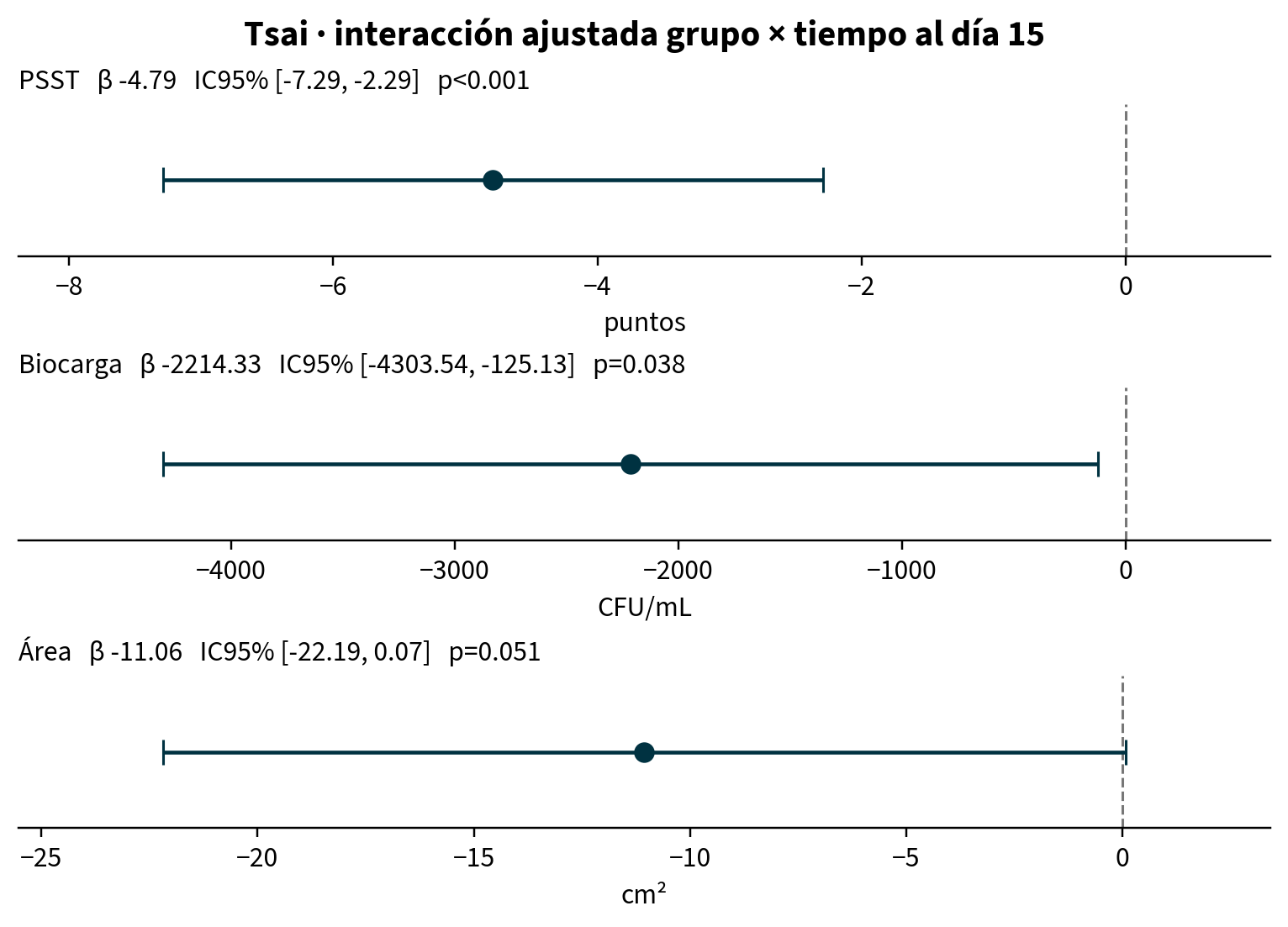
Tsai randomised 70 patients, 35 per arm. The analytical set was 65 (33/32), with 63 measurements at T1 (32/31) and 57 at T2 (28/29). Analytical-set size is distinguished from measurements available at each time point. Post-randomisation exclusions and discharges, adjustment for numerous covariates and semiquantitative CFU measurement limit interpretation. [14]
| Outcome | Time | Adjusted β (95% CI) | p |
|---|---|---|---|
| PSST (points) | T1/day8 | -3.01 (-5.18 to -0.85) | =0.006 |
| PSST (points) | T2/day15 | -4.79 (-7.29 to -2.29) | <0.001 |
| Bioburden (CFU/mL) | T1/day8 | -357.09 (-2,282.07 to 1,567.89) | =0.716 |
| Bioburden (CFU/mL) | T2/day15 | -2,214.33 (-4,303.54 to -125.13) | =0.038 |
| Area (cm²) | T1/day8 | -7.04 (-13.64 to -0.45) | =0.036 |
| Area (cm²) | T2/day15 | -11.06 (-22.19 to 0.07) | =0.051 |
PSST: Pressure Sore Status Tool (pressure-ulcer status scale). CFU/mL: colony-forming units per millilitre. β: unstandardised interaction coefficient; negative values favour the irradiated group over control for change from baseline. Published p values are not corrected here for multiplicity.
At day 15, PSST and bioburden have intervals excluding zero. Day-15 area does not (p=0.051); p=0.019 corresponds to the simple cross-sectional comparison, not that adjusted effect. A sentence in the text contradicts the table's bacterial significance; the discrepancy is retained. Funder m.h. bio-optical and manufacturer Delta Electronics are identified separately. Zero adverse events are not imputed among all 70 randomised patients. [14]
Goh reported bacterial decreases in 59 of 68 sessions involving 16 patients. Repeated sessions do not constitute independent human observations. Differences in design, exposure and analysis prevent that percentage from being combined with Tsai's GEE coefficient. [9,14]
Infections and acceptability
Kristensen included 635 residents: 76 in irradiated common areas, 89 in common areas and bedrooms, and 470 controls. Infection aIRRs were 0.12 (0.04–0.34) and 0.69 (0.23–2.07). With one residence per active arm, exposure is confounded with facility; these associations are therefore shown descriptively, and interpretation is limited to the observed association. [16]
Wang included 202 patients with identical UV in both arms. Infections of 13/101 versus 3/101 compare psychological care and do not estimate the UV effect. In Pratt, three volunteers wore clothing with Care222 during laboratory work and described minimal interference; the report concerns acceptability without a clinical infection outcome, personal dosimetry or formal UV-event surveillance. The 2023 publication remains contextual; the inventory counts the three recruitments from the 2024 report. [33,40]
Environmental evidence in occupied spaces
Thirteen environmental reports form the main synthesis. Air, surfaces, chemistry, dosimetry and manual operation are separated by outcome and type of human presence; reports from the same installation are not independent replications. Detailed records are in S7. E07/E08 remain outside the main synthesis as insufficient documentary evidence, in S8. [18–26,34–36,41,44,59]
In E14, operator presence is documented because the equipment requires controls to be held down during emission; it does not establish patient presence. Excluding E14 leaves 12 retained environmental reports. Requiring ordinary occupancy and removing the two manual applications E14/E15 leaves 11. Navarathna's interval is Bayesian, not a frequentist confidence interval. Joint exclusion of preprints E01/E14 leaves 11 environmental reports. These sensitivities change the inventory, do not estimate a pooled effect and do not change human results. [44,59]
In E04, MD8 and Andersen samplers represent the same clinic. Their already published combination is not reproduced as a two-study meta-analysis. The equivalent of 6.5 additional air changes per hour depends on a mixing model and approximately 10 ACH; it is not an independent ventilation measurement. In E12, the published SEM and replicate-based comparison are retained; fan experiments using 254-nm sources are not attributed to 222 nm. [21,36]
E15 · Yaghi et al., 2025 [59]
Yaghi et al. studied five surfaces in haematology and transplant workrooms at MD Anderson over 24 weeks: 440 plates, 220 before and 220 after, equivalent to 44 pairs per surface. A filtered 222-nm handheld device was applied at ≤2.5 cm for 20 s stationary and 20 s in a circular motion; no numerical radiant dose was reported. Operator presence during emission is inferred from this described manual procedure and is consistent with the criterion applied to E14; patient or other occupant presence is not presumed. [59]
Published mean reductions were 63.20% for the dictation device, 83.35% for the mouse, 78.62% for armrests, 77.31% for the desk and 53.41% for the keyboard. Table 1 reports p=0.0001 for the first four surfaces and p=0.371 for the keyboard. Published means of pair-specific percentages and their SEMs are preserved rather than replaced by ratios of means. The before/after design, adjacent areas and repeated measurements limit inference. It does not measure infections prevented or personal safety. The full publication is linked to abstract A246 by centre, duration, surfaces and plate count: they constitute one E15 family, distinct from E14. Commercial funding is disclosed in the source. [59]
| Surface | Mean reduction % ± SEM | p |
|---|---|---|
| Dictation device | 63.20 ± 7.73 | 0.0001 |
| Mouse | 83.35 ± 7.00 | 0.0001 |
| Armrests | 78.62 ± 3.65 | 0.0001 |
| Desk | 77.31 ± 4.78 | 0.0001 |
| Keyboard | 53.41 ± 10.37 | 0.371 |
Each row summarises 44 before/after pairs; the 220 pairs do not represent 220 people. SEM: standard error of the mean. Published mean percentages were retained; the keyboard showed no statistical difference at the 0.05 threshold.
Precision, certainty and missing evidence
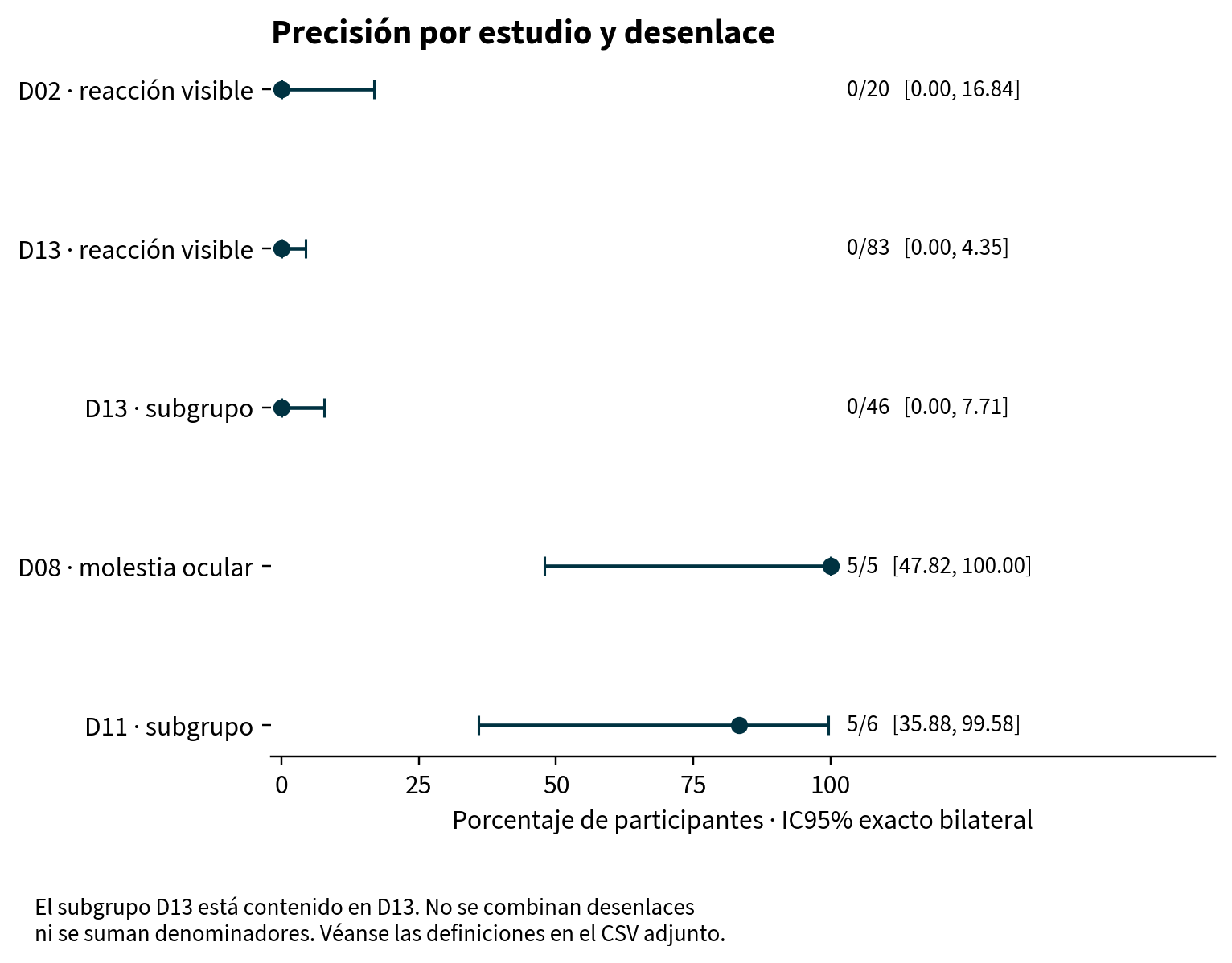
| Report / outcome | Events / N | Exact 95% CI |
|---|---|---|
| D02 · visible reaction | 0/20 | 0.00% to 16.84% |
| D13 · visible reaction | 0/83 | 0.00% to 4.35% |
| D13 · abnormal photosensitivity subgroup | 0/46 | 0.00% to 7.71% |
| D08 · ocular discomfort | 5/5 | 47.82% to 100.00% |
| D11_subgroup · ocular discomfort | 5/6 | 35.88% to 99.58% |
Intervals concern different outcomes and are not pooled. The subgroup of 46 is contained within Christou's 83 participants; its additional interval does not represent a new cohort. Zero observed events does not fix the true risk at zero. Intervals are presented as descriptive precision conditional on the binomial model. [6,12,15,32]
| Outcome | Certainty / main reason |
|---|---|
| Filtered-source erythema / CPD | Very low: selection, localised comparison, limited measures and precision. |
| Eye and comfort | Very low: mixed designs, losses, imprecision and source discrepancies. |
| Bioburden and wound status | Very low: high-RoB trial, losses and precision/clinical interpretation; uncontrolled pilot. |
| Infection prevention | No usable causal estimate; descriptive association of very low certainty. |
| Hand bioburden / acceptability | Very low: N=1 and N=3, dependence and limited outcomes. |
| Environmental metrics | No single GRADE valid for all metrics; clinical extrapolation highly uncertain. |
D17 lacks a DNA-damage estimate; it is not classified as a null effect. E15 contributes a before/after bioburden design, with repetition by surface and no infection outcome. Assessment of these reports retains the documented outcome and design scope. [58,59]
The attached GRADE matrix details each domain and prevents funding or participant count from replacing methodological judgement. Absence of deposited PRiVII results does not establish absence of publication: the targeted search identified no final report and retains that distinction. The PRiVII and ESKAPEE protocols are treated as follow-up documents, not results. [17,27,43]
Exclusions and relevant context
Wimmer studied implants and resected skin from 31 donors irradiated ex vivo. It remains X42: its results neither increase the human count nor estimate clinical infection. The reported dose was 22 mJ/cm²; 0.92 mW/cm²×24 s gives 22.08 mJ/cm². For implants, the text reports p=0.0009 and the caption p=0.009; both are preserved without choosing one. [38]
New exclusion reasons distinguish cellular/ex-vivo experiments, unoccupied chambers, prototypes without eligible tests, different wavelengths and secondary documents. Record R00222, DOI 10.1111/php.13807, contains a withdrawal notice for unit-conversion errors invalidating conclusions; it is not used as evidence. The correction to Welch 2018 is retained as integrity and conflict-of-interest context. [30,37]
Recovered decisions and technical documentation
Complete methods allow Hiwar, Leow, Nishiaki-Sawada and CLEAN experiments to be excluded from the occupied stratum: they were conducted without occupants or stopped emission when people were detected. Park represents occupants using CFD, not exposed students. Peng studies air chemistry under experimental conditions without documented simultaneous occupancy; Liang measures endotoxins, and Lv combines laboratory work with simulation. They remain technical or mechanistic context. Results are not added to the human corpus or presented as infections prevented. [50–57]
Primary abstracts A135 and A192 do not confirm people present during emission; A192 also does not unambiguously specify 222 nm. Absence of that information does not establish absence of occupants. A156's abstract 609 reports skin phototypes II–V and up to 3,000 mJ/cm² without unambiguously clarifying in vivo/ex vivo. They remain unclassifiable for this cut-off. A125 retains its exclusion after title correction and is not merged with A192. A246 links to the full E15 publication. [47,48,59]
Razhev presents a technological review of an ocular-surgery programme with historical series. It describes, among other data, 75 patients with herpetic keratitis, 25 per wavelength (193, 222 and 248 nm), and a favourable clinical response in 22/25 treated at 222 nm. These data are extracted into a contextual appendix: no new primary cohort is assigned, and pulsed therapeutic ablation is not extrapolated to environmental exposure. The review also mentions 41 refractive-surgery patients without sufficient breakdown to attribute them to 222 nm. Secondary classification applies the prior review criterion; it introduces no new exclusion for laser use. [46]
UVAura technical documentation is retained as context and identified separately from clinical evidence. Correspondence of its spectral file with report A179 and attribution to a Virgilio Rays device are not established. Its inherited calculations certify neither safety, regulatory compliance nor effects in people; values and reproduction scope are documented in S8. [49]
Discussion
Interpretation of findings
The synthesis provides a traceable matrix linking exposure, population, unit of analysis and outcome. Outcome-based organisation retains differences between biomarkers, bioburden and clinical results, while derived calculations allow precision of specific estimates to be checked. The synthesis identifies clinical signals in Tsai's trial and characterises hand-bioburden and acceptability observations from Hessling and Pratt under their respective designs. [14,39,40]
Safety assessment integrates clinical and molecular findings by organ, regimen and observation time. Checking units and denominators distinguishes erythema, CPD, discomfort and ocular staining, as well as irradiance and radiant exposure. D17 records are interpreted according to outcomes actually analysed. This organisation avoids attributing one result's scope to another. [6,7,12,15,58]
In the wound trial, adjusted PSST and bioburden coefficients are interpreted together with the uncertain day-15 area result. Post-randomisation losses and baseline care form part of the assessment of that effect, according to the primary analysis and Ingleman's commentary. The synthesis retains favourable and uncertain results together. [14,45]
Scope and limitations
Heterogeneity of exposures, populations, comparators and follow-up requires results to be interpreted by study and application. The 1,145 recruitments belong to different studies, and safety denominators are retained by outcome. Unretrieved texts and partial availability of historical exports constrain search coverage; their influence cannot be quantified. Bias and certainty assessments are interpreted according to the instruments described in Methods.
The synthesis retains original units, times and denominators. Published coefficients and study-specific intervals were used without estimating a pooled effect or reanalysing individual data. Follow-up losses remained distinct from absence of events. Interpretation distinguishes wound clinical status, area and bioburden; ocular symptoms and objective findings; and occupancy, ventilation and exposure conditions in environments. These features delimit application of results to other contexts.
Conclusions
In the included pressure-ulcer trial, the adjusted group×day-15 interaction favoured PSST (−4.79 points; 95% CI −7.29 to −2.29) and bioburden (−2,214.33 CFU/mL; −4,303.54 to −125.13). The area interval included zero (−11.06 cm²; −22.19 to 0.07). The clinical contribution of the synthesis is to specify these differentiated effects, interpreted with losses and trial design. Wound closure and reduced amputations are not established by these outcomes. [14]
In the dental clinic studied, the published reduction in airborne bacteria was 39.5% (95% CI 19–60) under the assessed ventilation and exposure conditions. The 13 retained environmental reports characterise different applications and outcomes; microbial reduction is interpreted as an environmental result rather than a pooled causal effect on human infections. [16,21]
The matrix integrates 17 human and 13 environmental reports, with 1,145 recruitments. Linking source, dosimetry, organ and follow-up identifies application-specific evidence and adverse effects. Results provide a documented basis for comparison; their scope does not include general clinical benefit or long-term safety. [5–8,12,15,58]
Disclosures
Authorship and conflicts of interest. Kevin Virgilio Morales Chamorro, M.D., and Gricell Jeraldina Báez Arévalo, M.D., are the authors. Both are affiliated with MedETechni, Santiago, Chile. Kevin is founder, CEO, shareholder and inventor associated with Chilean application 202602357 and PCT/CL2026/050115; Gricell is MedETechni's CMO. These relationships constitute professional, commercial and intellectual-property interests related to the technology assessed. Funding: no specific funding was reported for this review.
Author contributions (CRediT). Project administration and review and editing by Kevin Virgilio Morales Chamorro are documented. The full individual distribution, including Gricell Jeraldina Báez Arévalo, is presented in the editorial record.
Use of artificial intelligence. Generative artificial intelligence based on a language model, through Codex (OpenAI; GPT-6.1 Sol model), was used for accessible information retrieval, first assessment of records, assisted extraction, checking calculations and manuscript preparation. AI is not listed as an author. Responsibility for interpretation, final content and publication rests with the authors. The review uses published information and includes no new interventions or individual participant data.
Supplementary material. S1–S6 document methods, searching, analysis, data, maintenance and correspondence with PRISMA reporting elements. S7 contains individual human and environmental report records. S8 documents insufficiently classified cases, unretrieved main texts and technical context. Figures S1 and S2 depict documentary flow and study-specific intervals.
Data availability. The editable v1.13 database, CSV/JSON exports, dictionary, 2,552-record RIS library, 59 references, native responses from supplementary queries and the 27/09/2026 update, complete D17/E15 sources, tables, figures and executable code for derived calculations are supplied. Package v1.22 retains the 27 September evidence cut-off. The supplement identifies unavailable historical exports and primary texts. Published coefficients are represented without reanalysing individual data.
Licence. © 2026 Kevin Virgilio Morales Chamorro and Gricell Jeraldina Báez Arévalo. HF01 text, original figures and data compilation are distributed under Creative Commons Attribution 4.0 International (CC BY 4.0): https://creativecommons.org/licenses/by/4.0/. Original reproduction code is distributed under the MIT licence. Third-party materials retain their respective licences and rights.
References
- Page MJ, McKenzie JE, Bossuyt PM, Boutron I, Hoffmann TC, Mulrow CD, et al. The PRISMA 2020 statement: an updated guideline for reporting systematic reviews. BMJ. 2021;372:n71. doi:10.1136/bmj.n71.
- Sterne JAC, Savović J, Page MJ, Elbers RG, Blencowe NS, Boutron I, et al. RoB 2: a revised tool for assessing risk of bias in randomised trials. BMJ. 2019;366:l4898. doi:10.1136/bmj.l4898.
- Sterne JAC, Hernán MA, Reeves BC, Savović J, Berkman ND, Viswanathan M, et al. ROBINS-I: a tool for assessing risk of bias in non-randomised studies of interventions. BMJ. 2016;355:i4919. doi:10.1136/bmj.i4919.
- Campbell M, McKenzie JE, Sowden A, Katikireddi SV, Brennan SE, Ellis S, et al. Synthesis without meta-analysis (SWiM) in systematic reviews: reporting guideline. BMJ. 2020;368:l6890. doi:10.1136/bmj.l6890.
- Woods JA, Evans A, Forbes PD, Coates PJ, Gardner J, Valentine RM, et al. The effect of 222-nm UVC phototesting on healthy volunteer skin: a pilot study. Photodermatol Photoimmunol Photomed. 2015;31(3):159–166. doi:10.1111/phpp.12156.
- Fukui T, Niikura T, Oda T, Kumabe Y, Ohashi H, Sasaki M, et al. Exploratory clinical trial on the safety and bactericidal effect of 222-nm ultraviolet C irradiation in healthy humans. PLoS One. 2020;15(8):e0235948. doi:10.1371/journal.pone.0235948.
- Hickerson RP, Conneely MJ, Hirata Tsutsumi SK, Wood K, Jackson DN, Ibbotson SH, et al. Minimal, superficial DNA damage in human skin from filtered far-ultraviolet C. Br J Dermatol. 2021;184(6):1197–1199. doi:10.1111/bjd.19816.
- Eadie E, Barnard IMR, Ibbotson SH, Wood K. Extreme Exposure to Filtered Far-UVC: A Case Study. Photochem Photobiol. 2021;97(3):527–531. doi:10.1111/php.13385.
- Goh JC, Fisher D, Hing ECH, Hanjing L, Lin YY, Lim J, et al. Disinfection capabilities of a 222 nm wavelength ultraviolet lighting device: a pilot study. J Wound Care. 2021;30(2):96–104. doi:10.12968/jowc.2021.30.2.96.
- Sugihara K, Kaidzu S, Sasaki M, Ichioka S, Takayanagi Y, Shimizu H, et al. One-year Ocular Safety Observation of Workers and Estimations of Microorganism Inactivation Efficacy in the Room Irradiated with 222-nm Far Ultraviolet-C Lamps. Photochem Photobiol. 2023;99(3):967–974. doi:10.1111/php.13710.
- Kousha O, O'Mahoney P, Hammond R, Wood K, Eadie E. 222 nm Far-UVC from filtered Krypton-Chloride excimer lamps does not cause eye irritation when deployed in a simulated office environment. Photochem Photobiol. 2024;100(1):137–145. doi:10.1111/php.13805.
- Sugihara K, Kaidzu S, Sasaki M, Tanito M. Interventional human ocular safety experiments for 222-nm far-ultraviolet-C lamp irradiation. Photochem Photobiol. 2025;101(2):517–526. doi:10.1111/php.14016.
- Sugihara K, Kaidzu S, Sasaki M, Ichioka S, Sano I, Hara K, et al. Ocular safety of 222-nm far-ultraviolet-c full-room germicidal irradiation: A 36-month clinical observation. Photochem Photobiol. 2025;101(5):1343–1349. doi:10.1111/php.14052.
- Tsai YT, Li RT, Lai HJ, Chang WP. Application of 222-nm ultraviolet radiation C device to heal wounds and control infections in pressure injuries in intensive care unit patients: a randomized controlled trial. Intensive Crit Care Nurs. 2026;92:104162. doi:10.1016/j.iccn.2025.104162.
- Kaidzu S, Sugihara K, Tanito M. Human ocular-discomfort-free thresholds for 222 nm Far-UVC irradiation: A prospective interventional study. Photochem Photobiol. 2026 jul 24. Publicación anticipada en línea. doi:10.1111/php.70137.
- Kristensen MA, Mogensen EH, Nielsen SY, Holm CK. The potential effectiveness of far-UVC (222 nm) in preventing infections in long-term care facilities: a six-month nonrandomized controlled phase II trial. Antimicrob Steward Healthc Epidemiol. 2026;6(1):e165. doi:10.1017/ash.2026.10425.
- Nix HP, Meeker S, King CE, Andrew M, Davis IRC, Koto PS, et al. Preventing Respiratory Viral Illness Invisibly (PRiVII): protocol for a pragmatic cluster randomized trial evaluating far-UVC light devices in long-term care facilities to reduce infections. Trials. 2024;25(1):88. doi:10.1186/s13063-024-07909-0.
- Thyrsted J, Helbo Skaarup S, Fløe Hvass A, Joensen SM, Nielsen SY, Bendstrup E, et al. Anti-microbial effect of filtered 222nm excimer lamps in a hospital waiting area. medRxiv [prepublicación]. 2021 sep 10. doi:10.1101/2021.09.03.21263096.
- Buonanno M, Kleiman NJ, Welch D, Hashmi R, Shuryak I, Brenner DJ. 222 nm far-UVC light markedly reduces the level of infectious airborne virus in an occupied room. Sci Rep. 2024;14(1):6722. doi:10.1038/s41598-024-57441-z.
- Mogensen EH, Jensen JT, Skaarup SH, Hvass AF, Jeppesen CL, Rasmussen MH, et al. Ceiling-mounted far-UVC fixtures reduce the surface bioburden in occupied clinical areas. Infect Control Hosp Epidemiol. 2025;46(6):647–649. doi:10.1017/ice.2025.62.
- Welch D, Buonanno M, Tang Z, Shuryak I, Hashmi R, Belenky V, et al. 222 nm far-UVC to inactivate airborne bacteria in an occupied dental clinic. J Hosp Infect. 2026;168:105–113. doi:10.1016/j.jhin.2025.11.015.
- Li J, Um CY, Russell M, Destaillats H, Singer B. Evaluating Indoor Air Quality Impacts of Far-UVC (222 nm) in a Controlled Full-Scale Office Environment with Human Subjects. Proceedings of Indoor Air 2026 [Internet]. 2026 jun 18. Disponible en: https://escholarship.org/uc/item/9j94q9nr.
- Bansaghi S, Klein J. Evaluation of the antimicrobial effect of a far-uv radiation lamp in a real-life environment. Infect Prev Pract. 2024;6(4):100390. doi:10.1016/j.infpip.2024.100390.
- Osborne AO, Memic S, Cadnum JL, Donskey CJ. Evaluation of a wall-mounted far ultraviolet-C light device used for continuous air and surface decontamination in a dental office during routine patient care. Infect Control Hosp Epidemiol. 2024;45(10):1250–1252. doi:10.1017/ice.2024.109.
- Henderson J, Ma B, Cohen M, Dazey J, Meschke JS, Linden KG. Field study of early implementation of UV sources and their relative effectiveness for public health and safety. J Occup Environ Hyg. 2022;19(9):524–537. doi:10.1080/15459624.2022.2100404.
- Welch D, Hashmi R, Petersen C, Erde S, Brenner DJ, Nardell E. Film dosimetry for occupant exposure monitoring within Far-UVC installations. Photochem Photobiol. 2025;101(1):157–166. doi:10.1111/php.13960.
- Saber LB, Rojas M, Anderson DM, Anderson DJ, Claus H, Cronk R, et al. The effects of far-UVC irradiation on the presence and concentration of ESKAPEE pathogens on hospital surfaces: Study protocol for a multi-site, double-blinded randomized controlled trial in La Paz, Bolivia. Photochem Photobiol. 2026 jun 4. Publicación anticipada en línea. doi:10.1111/php.70110.
- Görlitz M, Justen L, Rochette PJ, Buonanno M, Welch D, Kleiman NJ, et al. Assessing the safety of new germicidal far-UVC technologies. Photochem Photobiol. 2024;100(3):501–520. doi:10.1111/php.13866.
- Buonanno M, Ponnaiya B, Welch D, Stanislauskas M, Randers-Pehrson G, Smilenov L, et al. Germicidal Efficacy and Mammalian Skin Safety of 222-nm UV Light. Radiat Res. 2017;187(4):493–501. doi:10.1667/RR0010CC.1.
- Welch D, Buonanno M, Grilj V, Shuryak I, Crickmore C, Bigelow AW, et al. Far-UVC light: A new tool to control the spread of airborne-mediated microbial diseases. Sci Rep. 2018;8(1):2752. doi:10.1038/s41598-018-21058-w.
- Pitts DG, Cullen AP, Hacker PD. Ocular effects of ultraviolet radiation from 295 to 365 nm. Invest Ophthalmol Vis Sci. 1977;16(10):932–939. PMID:908646.
- Christou E, Fenton L, Dawe R, Eadie E, Ibbotson SH. Far-ultraviolet-C exposure in patients with photosensitivity disorders. Br J Dermatol. 2025;193(3):564–566. doi:10.1093/bjd/ljaf193.
- Wang LJ, Wang MJ, Jing L, Su R, Jian QJ, Zhang ZY, et al. Impact of 222-nm ultraviolet disinfection combined with psychological care on the emotional and hospital infection of critical patients. World J Psychiatry. 2025;15(2):99449. doi:10.5498/wjp.v15.i2.99449.
- Sørensen SB, Dalby FR, Olsen SK, Kristensen K. Influence of Germicidal UV (222 nm) Lamps on Ozone, Ultrafine Particles, and Volatile Organic Compounds in Indoor Office Spaces. Environ Sci Technol. 2024;58(45):20073–20080. doi:10.1021/acs.est.4c03903.
- Fukutoku Y, Kikuchi H, Hoshi K, Narita K, Asari T, Miyazawa K, et al. The new 222-nm far ultraviolet-C lowers bacterial contamination to endoscopists during esophagogastroduodenoscopy. DEN Open. 2024;4(1):e292. doi:10.1002/deo2.292.
- Landry SA, Jamriska M, Menon VJ, Lee LYY, Magnin-Bougma I, Subedi D, et al. Ultraviolet radiation vs air filtration to mitigate virus laden aerosol in an occupied clinical room. J Hazard Mater. 2025;487:137211. doi:10.1016/j.jhazmat.2025.137211.
- Welch D, Buonanno M, Grilj V, Shuryak I, Crickmore C, Bigelow AW, et al. Author Correction: Far-UVC light: A new tool to control the spread of airborne-mediated microbial diseases. Sci Rep. 2021;11(1):18122. doi:10.1038/s41598-021-97682-w.
- Wimmer F, Schwaiger K, Scharfetter S, Reichert R, Mahrhofer M, Hitzl W, et al. The Effect of 222nm UVC Irradiation on Germ Density on Breast Implants and Epidermis. Plast Reconstr Surg. 2026 mar 30. Publicación anticipada en línea. doi:10.1097/PRS.0000000000013085.
- Hessling M, Sicks B, Lau B. Far-UVC Radiation for Disinfecting Hands or Gloves? Pathogens. 2023;12(2):213. doi:10.3390/pathogens12020213.
- Pratt L, Robertson R, Mintchev MP. Integrating Intelligent Control into Far UVC Wearable Garments for On-Demand Airborne Viral and Bacterial Protection. Healthcare and Medical Devices. 2024;130:104–108. doi:10.54941/ahfe1004843.
- Seyedi S, Ma B, Groves M, King H, Linden KG. Field Study and Evaluation of KrCl* Far UV-C Device Capability for Inactivation of Phi6 Bacteriophage. Photochem Photobiol. 2023;99(5):1293–1298. doi:10.1111/php.13767.
- Risk of bias tools. RoB 2: a revised Cochrane risk-of-bias tool for randomized trials [Internet]. Versión de 22 de agosto de 2019; extensiones para ensayos cruzados y por conglomerados [consultado el 8 de octubre de 2026]. Disponible en: https://www.riskofbias.info/welcome/rob-2-0-tool/current-version-of-rob-2.
- Schünemann HJ, Higgins JPT, Vist GE, Glasziou P, Akl EA, Skoetz N, et al. Chapter 14: Completing “Summary of findings” tables and grading the certainty of the evidence [actualizado en agosto de 2023]. En: Higgins JPT, Thomas J, Chandler J, Cumpston M, Li T, Page MJ, et al., editores. Cochrane Handbook for Systematic Reviews of Interventions. Versión 6.5 [Internet]. Cochrane; 2024 [consultado el 8 de octubre de 2026]. Disponible en: https://www.cochrane.org/authors/handbooks-and-manuals/handbook/current/chapter-14.
- Navarathna T, Jinadatha C, Corona BA, Coppin JD, Choi H, Bennett MR, et al. Efficacy of a Filtered Far-UVC Handheld Disinfection Device on Reducing Microbial Bioburden of Hospital Surfaces. medRxiv [prepublicación]. Versión 3. 2023 feb 27. doi:10.1101/2022.11.07.22282040.
- Ingleman J. The next step in ICU pressure injury care: 222-nm ultraviolet-C to reduce microbial burden and support healing in pressure injuries. Intensive Crit Care Nurs. 2026;92:104256. doi:10.1016/j.iccn.2025.104256.
- Razhev AM, Chernykh VV, Bagayev SN, Churkin DS, Kargapol’tsev ES, Iskakov IA, et al. Pulsed UV laser technologies for ophthalmic surgery. J Phys Conf Ser. 2017;793(1):012022. doi:10.1088/1742-6596/793/1/012022.
- St. Cyr G, Ray D, Leach L, Grimes L. Clear After a Year? Insights from a Pediatric Approach to Contact Precaution Discontinuation for Resistant Gram-Negatives Organisms. Antimicrob Steward Healthc Epidemiol. 2026;6(S1):s158. doi:10.1017/ash.2026.10684.
- SHEA Spring 2026 Abstracts Supplement – ERRATUM. Antimicrob Steward Healthc Epidemiol. 2026;6(1):e212. doi:10.1017/ash.2026.10802.
- HazardAssessment_UVAura_forweb.xlsx [hoja de cálculo técnica no publicada]. Hoja “Data 20cm”, fecha consignada: 09.10.25. Copia archivada en el expediente HF01 el 8 de septiembre de 2026.
- Peng Z, Day DA, Symonds GA, Jenks OJ, Stark H, Handschy AV, et al. Significant Production of Ozone from Germicidal UV Lights at 222 nm. Environ Sci Technol Lett. 2023;10(8):668–674. doi:10.1021/acs.estlett.3c00314.
- Liang Z, Cheung TY, Chan WL, Lim CK, Lai ACK, Lee PKH, et al. Negligible increase in indoor endotoxin activity by 222 nm far-UVC illumination on bioaerosols. Environ Sci Atmos. 2023;3(8):1212–1220. doi:10.1039/d3ea00059a.
- Hiwar W, Adamson CS, Brenner DJ, Fletcher LA, King MF, McQuaid JB, et al. Experimental analysis to quantify inactivation of microorganisms by Far-UVC irradiation in indoor environments. Build Environ. 2025;274:112734. doi:10.1016/j.buildenv.2025.112734.
- Leow CH, Saw LH, Low FS. Investigations of the UVC 222 NM air cleaning system in an air-conditioned room. Build Environ. 2024;265:111990. doi:10.1016/j.buildenv.2024.111990.
- Lv Y, Chen X, Wu W, Wu F, Wu X, Yuan W, et al. Experimental and numerical study on upper-room Far-UVC system under different ventilation schemes to disinfect airborne microorganisms in indoor environments. Build Environ. 2024;266:112108. doi:10.1016/j.buildenv.2024.112108. Corrigendum: Build Environ. 2025;267:112152. doi:10.1016/j.buildenv.2024.112152.
- Park S, Pei G, Mistrick R, Rim D. CFD Evaluation of Far-UVC and Air Cleaning Technologies in Classrooms without Mechanical Ventilation. J Hazard Mater. 2025;497:139723. doi:10.1016/j.jhazmat.2025.139723.
- Nishiaki-Sawada A, Osawa K, Nomoto R, Yamane K, Okumura Y, Fujina K, et al. Far Uv-C (222 Nm) Irradiation Devices (Care222®) Significantly Reduce Bacteria on Toilet Seats in Shared Toilets in a Nursing Home. SSRN [prepublicación]. 2024. doi:10.2139/ssrn.4861097.
- Vance ME, Bates KH, Benjamin S, Boyle D, Day DA, de Gouw J, et al. Overview of the Consumer products, Lights, Environmental Air cleaning in Normal conditions (CLEAN) Home Indoor Field Study. ChemRxiv [prepublicación]. Versión 1. 2026 ago 27. doi:10.26434/chemrxiv.15007982/v1.
- University of Michigan. The Effect of Violet Device Dosed Ultra Violet-C Light (UV-C) Exposure on Healthy Hand Skin. ClinicalTrials.gov [Internet]. Identificador: NCT05313555. Resultados publicados el 28 de mayo de 2026 [consultado el 27 de septiembre de 2026]. Disponible en: https://clinicaltrials.gov/study/NCT05313555.
- Yaghi L, Chemaly RF, Wilson-Dib R, Shropshire WC, Cantu S, Bhatti M, et al. The efficacy of a filtered handheld far-ultraviolet disinfection device for decontamination of high-touch surfaces in healthcare settings: a genomic bacterial analysis. Infect Control Hosp Epidemiol. 2025;46(10):1027–1034. doi:10.1017/ice.2025.10251.
History and versions
- 2026-10-08 · Reported acceptance
- 2026-10-09 · Spanish original published
- 2026-10-17 · Study classification updated
- 2026-10-27 · Title updated
- 2026-10-28 · Bilingual HTML, English PDF and publication archive
Assessment reports and correspondence are retained in the confidential editorial record.
Zenodo preservation copy of the volume
Editorial contact