
MEDICAL ENGINEERING & TECHNOLOGY
Virgilio
Rays®.
222-nm UVC technology. MedETechni engineering brought to wound-care research.
Open the clinical platformISO 13485IEC 60601CEFDA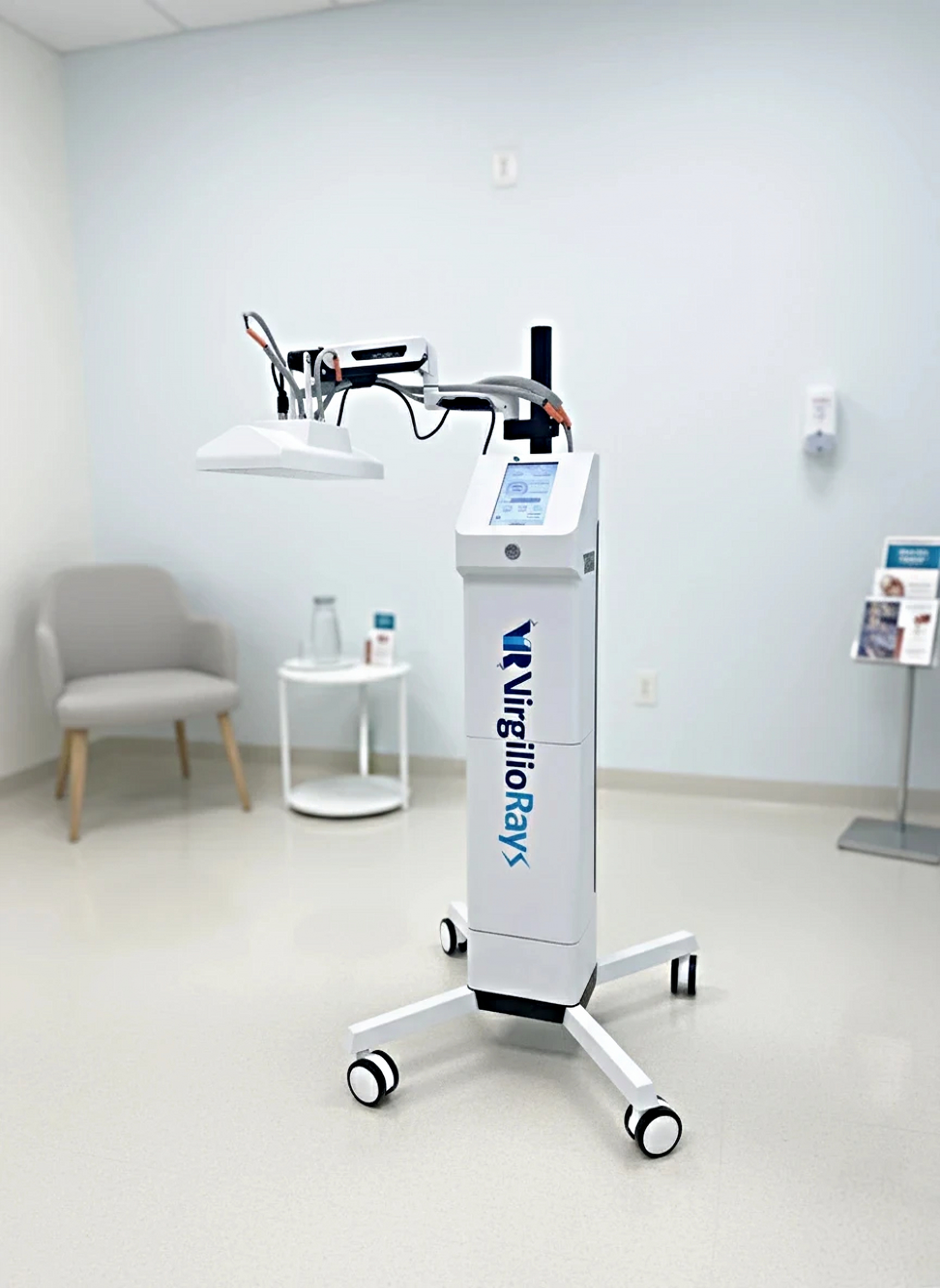
Virgilio Rays, in clinical practice.
Fundación Instituto Nacional de Heridas
Initial bacterial reduction
Mean of patient reductions · table 3
Bacterial reduction at day 15
Relative to baseline · post-application
Mean wound-area reduction
At 15 days · article abstract
Revista Latinoamericana de Enfermeras en Heridas y Ostomías
Vol. 6 · November 2025 · pp. 71–82
Study design and interpretation
Prospective uncontrolled series of 5 patients: 3 venous and 2 diabetic foot ulcers, with advanced wound care. Bacterial percentages average individual changes. The abstract reports 46% for area; the body, 48% (6.88 to 3.67 cm²). Findings describe this series and do not estimate a causal effect.
Aburto I; Alburquenque C; Espinoza G. Short-wavelength ultraviolet radiation in diabetic foot and venous ulcers with prolonged inflammation. 2025.
Clinical research, systematic reviews and experimental studies.
Explore all the evidenceDiscover Virgilio Rays.
What technology does Virgilio Rays use?
The device uses 222-nm UVC radiation. The FINH publication describes its application alongside advanced wound care in a five-patient series.
Where can I read the findings?
The FINH study is published in volume 6 of Revista Latinoamericana de Enfermeras en Heridas y Ostomías (2025). The evidence section also brings together five MedETechni Journal articles, with methods and sources.
How can I request information for my institution?
Contact the team to learn about the device, technical documentation and institutional demonstrations.